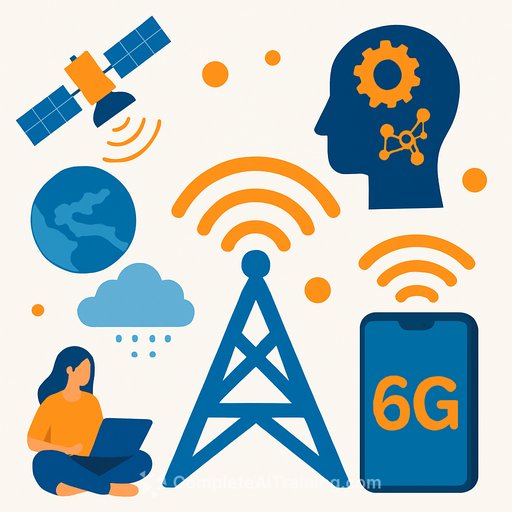
AI-Driven Wireless Network Management through Non-Terrestrial Networks and Open RAN
Meeting the growing demand for seamless connectivity requires fresh approaches to network design, especially beyond the limits of traditional terrestrial systems. Combining non-terrestrial networks (NTNs), such as satellites and high-altitude platforms, with open radio access networks (ORAN) can create wireless systems that are more scalable, flexible, and intelligent.
This integration addresses challenges like managing fast-moving platforms and optimizing limited resources. Using AI throughout the network lifecycle—from deployment to real-time operation—enables networks to adapt dynamically, improving efficiency and resilience. This approach is key to supporting future 6G applications in diverse environments.
Blending Terrestrial and Non-Terrestrial Networks for Ubiquitous Connectivity
As 6G networks advance, providing uninterrupted connectivity with higher data rates and capacity is critical. Non-terrestrial platforms extend coverage to remote areas and disaster zones, but managing these networks is complex due to constraints on size, weight, power, and mobility.
Traditional management strategies fall short in handling these unique NTN demands. Open RAN architecture introduces flexibility through disaggregation, virtualization, and embedded intelligence. Applying ORAN to NTNs allows dynamic network configurations, optimized resource use, and scalable operations.
This integrated framework leverages intelligent controllers powered by AI to proactively identify and resolve network issues. End-to-end orchestration ensures smooth coordination across multiple domains, enhancing service delivery and user experience. Future work will explore combining this framework with other emerging technologies to fully realize its potential.
Advancing Network Efficiency by Integrating ORAN with NTNs
To meet 6G requirements, researchers are developing network frameworks that merge ORAN’s open, virtualized design with NTNs' extended coverage. This fusion helps overcome power and weight limitations and the challenge of maintaining stable connections with moving platforms.
At the core is the flexibility ORAN offers through disaggregated components and virtualized functions. Dynamic “fronthaul splits” adjust data processing based on the specific NTN environment, optimizing performance compared to rigid traditional networks.
Enhancing RAN Intelligent Controllers (RICs) with AI enables distributed learning close to the network edge. This reduces latency and allows rapid, localized decision-making—essential for handling the variable conditions of NTNs.
An AI-driven orchestration layer manages the entire network, optimizing resources and ensuring smooth operation across terrestrial and non-terrestrial segments. Addressing challenges like on-orbit testing and upgrades with AI throughout the lifecycle makes the network more adaptable and scalable.
Creating Resilient Wireless Networks through NTN and ORAN Convergence
Combining NTNs with ORAN principles extends wireless coverage and increases network resilience. NTNs use platforms ranging from low Earth orbit satellites to drones, each with varying coverage, latency, and mobility characteristics.
ORAN’s open and disaggregated architecture suits these diverse platforms by enabling flexible network management. Research is ongoing to determine optimal placements for components like the RAN Intelligent Controller within NTN systems and to define functional splits that maximize efficiency.
While some studies focus on individual platforms, a comprehensive multi-platform approach is necessary to fully leverage ORAN in NTNs. This holistic strategy will enable adaptable networks that support future wireless demands with greater intelligence and scalability.
Extending Network Capabilities with ORAN Principles
Integrating ORAN into NTNs addresses the operational challenges of high-altitude, mobile platforms by embedding intelligence and flexibility directly into the network. The proposed frameworks support dynamic configuration and end-to-end orchestration, enabling networks to adjust in real time to varying conditions.
This integration supports diverse applications, including enhanced vehicle-to-everything (V2X) communication, and meets heterogeneous requirements across terrestrial and non-terrestrial domains. Open standards and multi-vendor compatibility are crucial for achieving resilient, widely accessible networks.
For management professionals seeking to understand emerging network technologies, this approach highlights how AI and open architectures can improve connectivity and operational efficiency—key factors for future communication infrastructure.
Explore more about AI-driven network solutions and training options at Complete AI Training.
Your membership also unlocks: