
AI news ·
AI energy and water demands reshape insurance risk as sovereign strategies concentrate infrastructure
AI's energy and water demands are now a material underwriting concern for insurers. Data centres powering AI tools face property, liability, and ESG exposures as regulation tightens disclosure requirements.
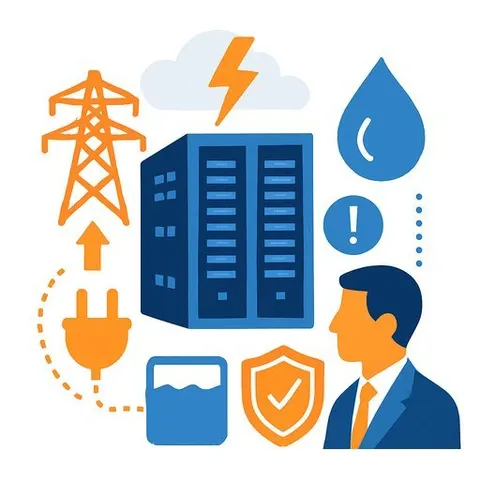
AI's environmental cost is now an insurance problem
Insurers are facing a new risk category as artificial intelligence's energy and water demands strain infrastructure worldwide. Data centres powering generative AI tools consume far more resources than traditional computing, forcing underwriters to reassess everything from property exposure to board-level liability.
A single AI chatbot query uses several times more electricity than a traditional web search, particularly for complex requests requiring multi-step reasoning. With billions of prompts processed daily through tools like ChatGPT, the cumulative effect is material. Insurance group Everywhen warned that unchecked growth in AI workloads could put significant pressure on natural resources.
Data centre concentration creates new exposures
Large, high-value data centre campuses are becoming critical infrastructure for AI operations. These facilities cluster around a limited number of power grids and fibre routes, concentrating risk in ways traditional underwriters are still learning to assess.
Property and business interruption underwriters now evaluate how AI-driven utilisation affects load profiles, cooling requirements and resilience. Traditional perils like fire and equipment breakdown remain relevant, but the risk profile has shifted as data centres become more dependent on stable, uninterrupted power supply.
Carriers are also scrutinising the carbon intensity of power sources backing their AI-intensive clients. This feeds directly into ESG discussions, as insurers weigh their own net-zero commitments against expanding AI capacity in their portfolios.
Water use emerges as a hidden cost
Modern data centres rely on intensive cooling systems to prevent hardware overheating. Many designs depend on significant volumes of freshwater, both on-site and indirectly through power generation.
Academic research shows that training and operating large language models can consume millions of litres of water annually at a single facility, depending on cooling technology and local climate. A substantial share of global data centre capacity sits in water-stressed regions, creating conflict risk with municipal, agricultural and industrial users during droughts or heatwaves.
This introduces multiple liability dimensions. Physical exposures include operational constraints or forced shutdowns where water use is curtailed. Regulatory and social pressures may follow if operators are perceived to be worsening local shortages. Directors' and officers' claims could arise if disclosures around water use, cooling strategies or "green AI" marketing are challenged.
Regulation tightens transparency requirements
The European Union's AI Act and parallel measures on data centre reporting are expected to increase transparency around power use, cooling methods and emissions. In the US and other major markets, securities and prudential regulators are moving toward more detailed climate and technology risk disclosures for large corporates and financial institutions.
These developments influence liability and regulatory investigation exposure for clients, particularly in directors' and officers' and professional indemnity lines. More standardised data on energy and water use can feed into underwriting, risk engineering and ESG-linked cover design.
Sovereign AI concentrates risk in new ways
Countries are exploring "sovereign AI"-systems designed, built and governed nationally to retain control over security, data handling and energy sourcing. Sovereign strategies can encourage greener choices, but they may also concentrate large amounts of compute capacity in particular jurisdictions or metropolitan areas.
This concentration creates geographic risk clustering that differs from the distributed nature of traditional cloud computing.
AI adoption spreads environmental impact across sectors
Most large organisations now use AI in at least one business function. Adoption is climbing among small and mid-sized enterprises as models become easier to access via cloud platforms. Manufacturing, financial services, logistics, healthcare and retail clients all contribute to rising compute demand.
As AI embeds across sectors, its environmental impacts are no longer confined to technology giants. Insurers are updating proposal forms and risk surveys for data centres, cloud providers and AI-intensive corporates to capture detail on energy mix, cooling technology, water sources and local climate exposures.
Some carriers are exploring how to support risk-reducing investments-waste-heat reuse, advanced cooling, relocation to less water-stressed regions-that strengthen the insurability of AI infrastructure.
For insurance professionals, the message is clear: AI's environmental footprint is now a material underwriting consideration, not a peripheral ESG concern. Understanding these exposures will separate informed underwriters from those caught unprepared as regulation and disclosure requirements tighten.
Learn more about AI for Insurance and the business implications of Generative AI and LLM technologies.