
AI news ·
AI finds practical footing in construction and logistics as industries report measurable returns
AI is delivering its biggest returns not in self-driving cars, but on construction sites and in warehouses. Tools that automate blueprint counting and delivery routing are already cutting costs and saving workers hours of repetitive work.
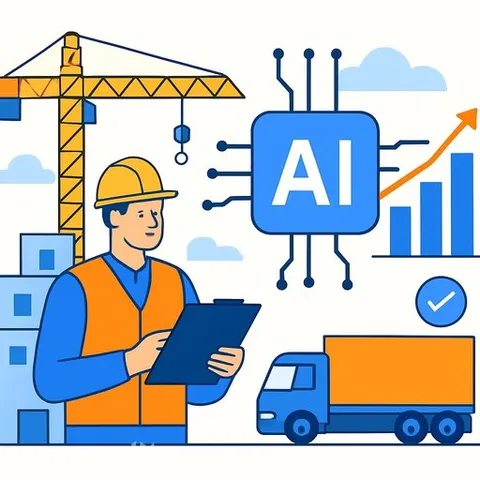
The Real AI Boom Is Happening in Construction and Logistics
Self-driving cars and chatbots dominate headlines. Meanwhile, the largest financial returns from AI are unfolding on construction sites and in warehouses, where the technology solves specific, high-value problems in controlled environments.
Unlike the unpredictable chaos of public roads, construction projects and supply chains operate within defined systems. An AI can learn to read blueprints or optimize warehouse layouts because the variables, while complex, are measurable and finite.
These industries generate data at scales humans cannot process efficiently. Blueprints, supply chain schedules, inventory logs, and safety reports accumulate constantly. AI finds patterns and insights in those massive datasets, converting complexity into competitive advantage.
Why These Industries Win With AI
Even small mistakes in construction and logistics carry enormous costs. A miscalculation on materials erases project margins. An inefficient delivery route wastes fuel and time. That high-stakes environment means modest AI improvements deliver measurable value.
A labor shortage in skilled trades compounds the problem. Rather than replacing workers, AI tools let smaller teams accomplish more. The software handles repetitive tasks-measurement, counting, data entry-freeing experienced professionals to focus on strategy and complex decisions.
The practical benefits are clear:
- Reducing costly human errors in measurement and counting
- Automating time-consuming administrative work
- Predicting project delays and supply chain disruptions before they occur
- Optimizing material use to cut waste
- Monitoring job sites for safety hazards in real time
Construction: From Manual Counting to Automated Takeoffs
Construction bidding traditionally required estimators to spend days hunched over blueprints, manually counting every pipe, valve, and fixture. One mistake could cost a company the job or eliminate its profit margin.
Specialized AI software is changing that process. Tools like TaksoAi use computer vision to identify and count components-pipes, ducts, and over 38 fitting types-directly from digital blueprints. The software processes most mechanical plans in under 15 minutes, saving estimators up to 50% of their time.
The estimator reviews the AI's findings and approves them. The software removes tedious work, not expertise. Professionals can then focus on strategy and winning more projects.
Logistics: Dynamic Routing and Warehouse Automation
Modern warehouses deploy autonomous mobile robots to sort and move packages. These systems improve throughput and reduce the variability that comes with human-only operations.
AI platforms constantly recalculate delivery routes based on real-time variables: traffic, weather, delivery windows. This dynamic routing reduces fuel consumption and emissions while ensuring on-time arrivals.
The Financial Case Is Already Clear
Business-to-business AI lives or dies by return on investment. A recent Deltek report found that nearly half of UK firms in architecture and engineering are seeing productivity or cost improvements from AI. Twelve percent report significant ROI.
The biggest wins come from augmenting workers, not replacing them. Skilled trades are leading AI adoption because they see it as a capability multiplier-experienced professionals handle complex problem-solving while AI handles repetitive work.
Concerns over accuracy and trust remain barriers for some firms. But tangible, measurable benefits are driving rapid adoption across construction and logistics.
The Comparison: Human-Only vs. Human-Plus-AI
Construction bidding: Manual takeoff requires 20-40 hours counting materials from blueprints, with high error risk. AI-powered takeoff processes plans in under one hour, with human review for accuracy.
Delivery routing: Fixed routes planned once per day cannot adjust to real-time changes. AI constantly optimizes routes based on current traffic, weather, and delays.
Warehouse picking: Workers walk miles of aisles, limited by human speed. Autonomous robots bring shelves to workers, drastically cutting travel time and fulfillment speed.
Project risk analysis: Managers rely on experience to spot issues and can miss subtle patterns. AI analyzes thousands of data points to flag risks like potential delays or safety hazards.
The Quiet Revolution
The real AI boom solves specific, high-value problems in controlled environments. It's less about creating artificial consciousness and more about building tools that make human workers better at their jobs.
Self-driving cars and creative chatbots capture imagination. The "boring" AI optimizing a supply chain or pricing a building correctly is quietly generating billions in value. Next time you see a new skyscraper or receive a package, the invisible AI behind faster, cheaper, and more efficient delivery is likely at work.
Learn more about AI for Real Estate & Construction and AI for Operations.