
AI news ·
AI frees workers for empathy and creativity, Rochester experts say
AI won't eliminate jobs, but it should take over the repetitive cognitive tasks that drain workers, say University of Rochester experts. Human judgment, empathy, and creativity remain scarce - and that's the point.
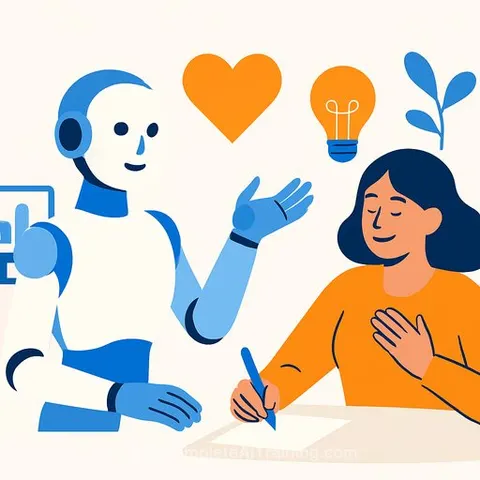
AI Should Free Workers From Drudgery, Not Replace Them
University of Rochester experts say the wrong question is whether artificial intelligence will eliminate jobs. The right question is which parts of human work should never have consumed so much human attention in the first place.
Daniel Keating, a clinical associate professor of information systems and AI at the Simon Business School, sees AI as a tool that will reshape how people spend their time at work-not eliminate them. The technology handles repetitive cognitive tasks well. Human judgment, leadership, and creativity remain essential.
"You have to use it as a creative palette to which you bring your best ideas and hone your strongest questions," Keating said. "The directive is to have AI make your ideas better."
The Real Value Sits With Humans
Kathleen Fear, senior director of digital health and AI at University of Rochester Medicine, sees AI as most useful when it creates room for distinctly human work: empathy, creativity, judgment, and connection. That includes the messier human elements-mistakes, emotions, intuition, uncertainty-that remain features, not bugs.
"AI can feel like something happening to people-something they're not in control of, that will change their lives and jobs without them knowing what to do about it," Fear said.
Jonathan Herrington, an assistant professor of health humanities and bioethics in the School of Medicine and Dentistry, said public conversations about AI oversimplify what human intelligence actually does. Some dimensions of human thinking remain difficult to replicate.
"There's a certain degree of taste and style-developing the right questions, selecting the most salient sources, even finding the perfect metaphor-that still matters," Herrington said.
Where AI Falls Short
AI cannot match humans in two areas: emotional labor and human discernment. Herrington pointed to shortages in childcare, elder care, nursing, medicine, and teaching.
"Human empathy is not yet an ample commodity," he said. "It's actually really scarce."
The paradox is that modern workplaces force people to spend enormous time on administrative and cognitive tasks that undermine opportunities for meaningful human interaction. Herrington said the positive vision for AI is that those tasks become less important, freeing workers to spend more time connecting with other people.
Fear sees tools like Dragon Ambient eXperience (DAX)-which records patient appointments with consent-as ways to reduce administrative burdens and mitigate burnout from unpaid after-hours work.
Three Critical Risks
All three experts caution against treating AI as neutral or infallible.
Bias and drift: AI tools trained under one set of conditions may behave differently as populations, workflows, or environments change. "The biggest risk is how tools perform when conditions change over time," Fear said. "We need to be watching."
False intimacy: Herrington worries that AI platforms designed to maximize engagement may encourage affirmation and dependency rather than honesty or accountability. "These systems are built to maximize engagement," he said. "They are almost always going to be sycophantic because that's what draws people in." Meaningful relationships involve friction, independence, and moral challenge-things AI systems are unlikely to provide.
Lack of accountability: AI will never speak truth to power, Herrington said. That's what distinguishes good teachers, supervisors, and doctors from systems designed to please.
How to Move Forward
Rather than avoiding AI, Fear believes the best response is informed engagement. "The most valuable thing people can be doing with AI is getting in and playing," she said. Understanding the technology helps workers shape it and sort hype from reality.
Generative AI tools like ChatGPT, GitHub Copilot, and Claude could democratize innovation by allowing more people to prototype ideas, build software, or streamline workflows without coding expertise.
"The sustainable future of AI depends on developing a culture where everyone is educated on AI," Fear said.
What Makes Humans Irreplaceable
Keating pointed to what he calls "the human mess"-uncertainty, free will, storytelling, mistakes-as qualities purposely excluded from AI systems but central to human achievement. These traits enable breakthroughs.
"We write the works of Shakespeare. We create the art of Picasso. We cure polio," Keating said. "All of these seeming 'deficiencies' are actually what allow us, as humans, to make those incredible leaps."
What HR Leaders Should Know
For HR professionals, the implications are direct. AI can absorb repetitive documentation, technical bottlenecks, and administrative overload-the work that burns out employees and prevents them from doing their best work.
The future of work depends on using AI to free people for the tasks machines still struggle with: building culture, developing talent, making judgment calls about people, and creating connection. That's where human work becomes more human, not less.
HR leaders interested in implementing AI effectively should explore resources tailored to your role. AI for HR Managers provides practical guidance on integrating these tools into talent management and workforce planning.