AI eyewear sales spiked over Spring Festival - here's how to sell into the surge
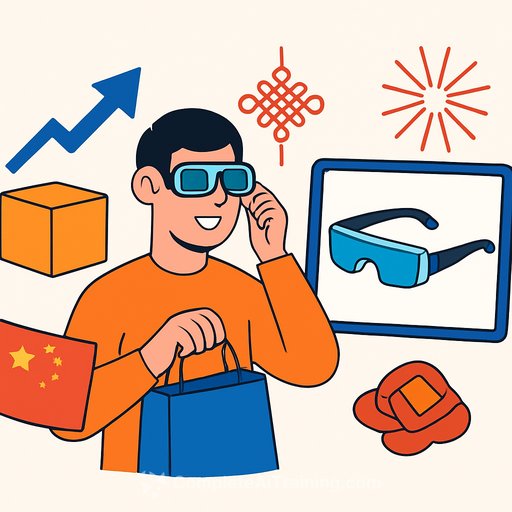
AI glasses moved fast in China during the Spring Festival. Shenzhen's Huaqiangbei electronics hub reported a 35% year-on-year revenue jump, led by AI glasses with sales up as much as 80%. Drones and robots followed, rising up to 50%.
The catalyst: AI glasses were added to the national subsidy in January, alongside smartphones, tablets, and smartwatches. The subsidy covers products priced under 6,000 yuan with a 15% discount, capped at 500 yuan per item.
Who's buying - and why it matters for your pitch
- Educators and executives: Using integrated teleprompter features to speak without scripts in classrooms and meetings.
- Youth and highly educated early adopters: Testing frames in-store, drawn to hands-free prompts and on-the-go content.
- Retail momentum: Traditional optical stores are turning into demo hubs - high foot traffic, curious buyers, quick trials.
Trade show buzz (e.g., CES demos of RayNeo's X3 Pro) has primed interest, but buyers still need proof the glasses fit real work scenarios.
Product realities you must address upfront
- Weight: Many models are 40-80g vs ~20g for standard frames.
- Battery: Promised 4-8 hours can drop to 2-3 hours with video recording or navigation.
- Perception: Some shoppers see the category as a novelty - not a daily essential.
Offer design: use the subsidy to remove friction
- Price to capture the cap: Position SKUs in the 3,000-5,999 yuan range so buyers get the full 500 yuan benefit.
- Instant savings at checkout: Show "15% off (up to 500 yuan) applied now" on receipts and shelf labels.
- Bundle for battery reality: Add charging cases, power banks, or spare cables. Message it as "all-day kit."
- Event windows: Tie promos to local festivals and school terms to match educator demand cycles.
- Trade-in and financing: Lower the first purchase risk; keep monthly outlay simple and visible.
Positioning that converts (use-case first)
- For educators and speakers: "Speak naturally. Subtle teleprompter cues in your eyeline. No more memorizing or rigid scripts."
- For executives and sales leaders: "Hands-free prompts for meetings, quick access to notes, and discreet reminders to keep you on message."
- For creators and youth: "Point-of-view recording and guided navigation for content on the move - without pulling out your phone."
Objection handling that actually works
- "They feel heavy." Run a 60-second fit session. Offer lighter models and nose pad swaps. Close with a 7-day comfort guarantee.
- "Battery won't last." Set expectations honestly: 2-3 hours with video/navigation. Solve with a bundled charger and quick-charge demo.
- "Is this just a gimmick?" Lead with one anchored workflow: public speaking with a teleprompter for smoother delivery. Show a 30-second live demo.
In-store and channel moves
- Demo-first merchandising: Set up a mirror station with a short teleprompter script. Let shoppers try, record, replay.
- Subsidy signage everywhere: "Save up to 500 yuan today" on shelf talkers, QR codes, and checkout screens.
- Optical store partners: Train staff on fit, comfort, and one core use case. Incentivize demos, not just sales.
- Enterprise outreach: Target schools, training centers, and corporate comms teams for small-batch pilots (10-50 units).
- Attach-rate plan: Push accessories (chargers, cases) and service add-ons (lens swaps, fit adjustments) at the demo table.
Market data you can sell with
China shipped 623,000 smart eyewear units in Q3 last year, up 62.3% from 2024, representing about 14.5% of the 4.3 million global units in the same period. In China, 35.7% of smart eyewear sold featured AI functions, and 53.9% connected to large language models, per IDC. IDC projects shipments in China to reach 4.5 million units in 2026, implying strong annual growth. A Bank of America report estimates Chinese makers supply over 80% of the industry's components and devices.
Use these stats in decks and shelf materials. Cite IDC for credibility in B2B pitches.
KPIs to track this quarter
- Subsidy utilization rate (% of eligible sales that claim the discount)
- Demo-to-sale conversion rate and average demo length
- Accessory attach rate and revenue per demo
- 7-day and 30-day return rates (watch fit and battery complaints)
- Pilot-to-rollout conversion for schools and enterprises
- Average selling price before vs. after subsidy
Next steps for your sales plan
- Pick one hero use case per segment (speaking for educators, meetings for executives) and script the demo around it.
- Reprice key SKUs to fully capture the 500 yuan subsidy cap and print new shelf labels this week.
- Stand up two pilot programs: one school, one corporate team, with clear before/after performance metrics.
- Train floor staff on fit, comfort adjustments, and fast battery guidance. Incentivize demos.
If you want structured training for frontline teams selling AI hardware, start with the AI Learning Path for Sales Representatives.
Your membership also unlocks: