
AI news ·
AI handles 37% of entry-level tasks in India, Cognizant and Pearson study finds
Indian firms use AI for 37% of entry-level tasks, above the 33% global average. This shift requires HR to prioritize soft skills and AI oversight over basic task execution.
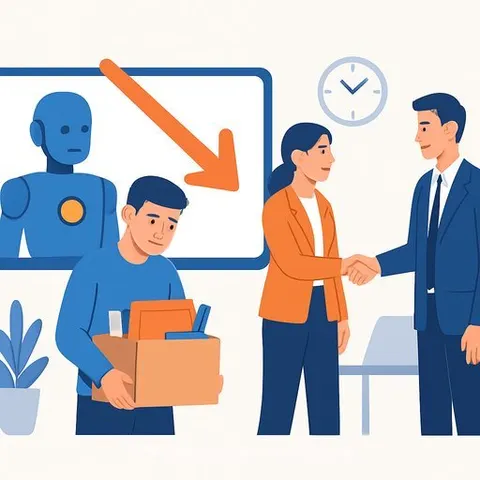
Indian businesses now use AI for 37% of entry-level tasks, above the global average of 33%, according to a study by Cognizant and Pearson that surveyed 750 HR leaders across the US, UK, and India. The findings signal a rapid rewiring of junior roles - one that demands HR teams rethink hiring, training, and the very shape of early-career work.
The pace is sharpest in India, where 18% of HR leaders said AI already handles half or more of entry-level work. Within five years, 96% expect early-career jobs to evolve into positions where employees supervise or manage AI systems, and 94% believe AI will create new entry-level roles that do not yet exist.
Eighty percent of Indian organisations say AI enables workers to focus on higher-value tasks, slightly above the global figure of 77%. That shift puts a premium on oversight, judgement, and the ability to interpret AI output - skills that recruiters are now ranking above simple task execution.
The new skills equation
Soft skills have become non-negotiable. Nearly all HR professionals - 97% - said adaptability, problem-solving, and human judgement matter more than ever. Degree preferences are shifting too: two-thirds now value liberal arts qualifications more because of AI, and 69% consider broad, interdisciplinary backgrounds more important for early-career hires than narrowly specialised degrees. In India, 65% of respondents shared that view.
AI literacy is no longer confined to technical departments. Almost every HR leader surveyed places greater weight on AI skills even for non-technical roles; in India, 91% said those skills have become more important for such positions. Resources that help HR teams navigate this shift, such as AI for Human Resources, give practical guidance on embedding AI-readiness into workforce planning.
The training gap
Demand for AI training is surging, but supply is not keeping up. Across the three markets, 91% of HR professionals said employee demand for AI training increased over the previous 12 months, yet 60% admitted their learning and development programmes cannot match the speed at which AI is changing jobs. In India, the gap widened to 63%.
Employers are split on forward planning. Only 54% of HR leaders said their organisations proactively arrange AI upskilling in anticipation of role changes, leaving 46% without such measures. India did show relative strength in formal training support: 63% of organisations there have allocated time for AI training, compared with 49% in the US.
Yet hiring remains difficult - 61% of Indian organisations report challenges finding the right talent.
Middle managers in the spotlight
The study identifies middle managers as the linchpin of AI adoption. 95% of HR leaders believe these managers are essential to ensuring employees use AI effectively, and 92% said they play a crucial role in redefining jobs as AI reshapes day-to-day work.
Rajesh Varrier, President - Global Operations and Chairman & Managing Director, Cognizant India, said: "India is at the forefront of how AI is transforming entry-level work, with organizations already embedding AI into day-to-day operations at scale. We are seeing a fundamental redesign of roles, where early-career talent is expected to work alongside AI and focus on higher-value outcomes. This shift underscores the necessity for extensive reskilling and improved managerial effectiveness, both of which are key in an economy increasingly shaped by AI."
Cognizant hired 20,000 fresh graduates in 2025 and expects to exceed that total in 2026, signalling that early-career recruitment remains strong even as AI rewrites job descriptions. Kathy Diaz, Chief People Officer, Cognizant, said: "AI is reshaping the talent landscape and exposing the limits of traditional talent and learning models. With the fundamental shift in entry-level tasks and skill requirements changing rapidly, organizations must rethink how they hire and develop talent at pace."
Ali Bebo, Chief Human Resources Officer, Pearson, said: "As work evolves, the most successful organizations will focus less on replacing tasks and more on building the capabilities that help humans and AI work together. That starts with early-career talent."
Why this matters for HR
The data makes clear that AI is not eliminating entry-level jobs - it is redefining them into roles that demand judgement, cross-disciplinary thinking, and the ability to work alongside automated systems. For HR leaders, this means overhauling job profiles to prioritise soft skills and AI literacy across all functions, building learning programmes that can keep pace with the speed of change, and equipping middle managers to act as role architects. Senior HR executives looking to shape an AI-ready talent strategy can take a deep dive with the AI Learning Path for CHROs. Without deliberate reskilling and manager enablement, the training gap will widen - and organisations will struggle to fill the very roles they are creating.