Using AI to Enhance Galaxy Research Efficiency
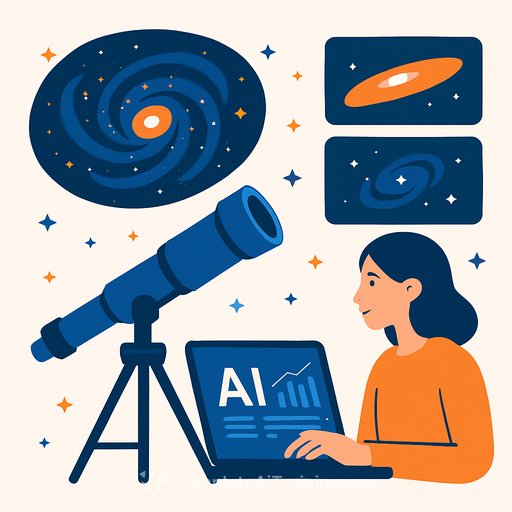
A recent graduate from Memorial University of Newfoundland developed an AI-driven image-processing method that predicts how galaxies might appear in different wavelengths of light. This technique aims to assist astronomers in studying distant galaxies more effectively.
Youssef Zaazou, who completed his master's of science, described the approach as translating galaxy images across various wavelengths. By adapting existing AI tools and carefully curating training data, he created a model capable of generating these predictions.
This method allows researchers to focus on specific regions of the sky, highlighting potentially interesting areas before allocating valuable telescope time. "Instead of having to look at an entire region of sky, we can get predictions for certain regions and figure out, 'Oh this might be interesting to look at,'" Zaazou explained.
Collaboration and Publication
Zaazou collaborated with his supervisors, Terrence Tricco and Alex Bihlo, to publish their findings in The Astrophysical Journal, a leading publication by The American Astronomical Society. Their research could help justify the use of high-demand telescopes, such as the Hubble Space Telescope, which has a competitive allocation process.
The Role of AI in Astronomy
Both Tricco and Zaazou emphasize that AI is intended to complement, not replace, traditional astronomical research methods. Tricco notes the potential for AI to guide telescope development and assist astronomers by predicting observational outcomes, leading to more targeted and efficient exploration.
Despite some hesitation in the astronomy community towards adopting AI and machine learning, Tricco encourages wider awareness of these tools. He highlights growing expertise in AI at Memorial University and its applicability beyond astronomy, contributing to the local tech ecosystem.
Looking Ahead
Though Zaazou has completed his studies, he hopes this research marks just the beginning of further advancements using AI in astronomy. He humbly refers to his contribution as a "pebble" but values being part of the scientific progress in understanding the cosmos.
"I'm an astronomer. And it just feels great to be able to say that and to be able to have that little contribution because I just love the field and I'm fascinated by everything out there," Zaazou shared.
- Research paper: The Astrophysical Journal
- Learn more about AI applications in science at Complete AI Training
Your membership also unlocks: