
AI news ·
AI helps identify fake news but still requires human supervision
AI is being trained to fight the misinformation it helped create. A version of ChatGPT reduced belief in conspiracy theories by an average of 20% in a 2024 study.
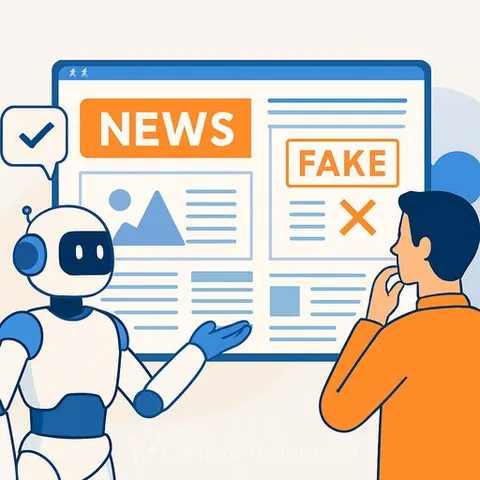
Artificial intelligence, a technology that has flooded social media with fabricated images, deepfake videos, and bot-driven propaganda, is now being used to combat the very misinformation it helps create. Researchers are training machine learning models and large language models to parse human language, verify claims, and summarize sprawling online narratives, tools that could assist journalists, fact-checkers, and platforms sorting fact from fiction.
Pattern-based detection meets real-world limits
Machine learning has long been applied to truth-checking. Researchers feed models claims that human fact-checkers have labeled true or false, and the systems learn text features - excessive capitalization, emotional language, certain phrase structures - associated with bogus statements. Zois Boukouvalas of American University, who coauthored a review on this approach, said a model trained on Covid-19 misinformation tweets agreed with human fact-checkers about 90 percent of the time.
Yet these systems falter outside tightly controlled datasets. They are often trained on narrow time periods or single platforms, limiting their usefulness for the messy, ever-shifting real-world information landscape. That fragility has pushed scientists toward Generative AI and LLM tools like those powering ChatGPT, which absorb patterns from vast internet-scale training data and can also handle images and audio.
LLMs join the fact-checking pipeline
Large language models show promise for analyzing claims because of their deep linguistic knowledge, said Thanh Thi Nguyen of the University of the Sunshine Coast in Australia. However, they also hallucinate - confidently generating false answers when evidence is ambiguous or missing. The statement "Mark Carney is prime minister" is true only in Canada; without context, an LLM can misjudge it.
Dorsaf Sallami of McGill University and Mila has developed a browser extension that lets an LLM search the web for current information before answering. Even then, accuracy varies: an early 2025 version of Grok agreed with human fact-checkers only about 55 percent of the time in preliminary tests. Human fact-checkers agree among themselves roughly 64 percent of the time on the same claims, highlighting how difficult ambiguous verification is.
To improve, Sallami trains her model to recognize insufficient evidence and ask clarifying questions rather than forcing an immediate answer. Similarly, the Dubawa fact-checking bot used by the Nigerian Center for Journalism Innovation and Development, which runs on WhatsApp, tells users when there isn't enough information to decide, said investigative journalist Lademi Aborisade. That triggers deeper human investigation.
Looking at how misinformation is built
Other projects focus not on what is claimed but on the linguistic fingerprints of disinformation. The European research collaboration AI4Trust prompted an LLM to detect 42 characteristics, including conspiratorial allusions and emotionally manipulative language. Georgios Petasis of the Demokritos research center in Greece said the model agreed with human fact-checkers 70 percent of the time - a rate he considers useful for flagging suspicious content for further review.
Platforms likely already deploy LLMs for detection. YouTube said it uses automated systems alongside human reviewers and removed 11,337 videos for violating misinformation policies in the last quarter of 2025. TikTok, Meta, and X did not respond to requests for comment. Jevin West of the University of Washington suspects that recent court rulings holding social media companies liable for harm to young users could push them to strengthen content moderation, including misinformation enforcement.
Narratives, not just individual claims
LLMs also excel at clustering millions of related posts into coherent narratives. West's group uses them to track how misleading storylines emerge and evolve, citing the "stop the steal" conspiracy theory that followed the 2020 U.S. election. Summarizing the overarching narrative lets fact-checkers address the big picture rather than chasing every single post. "If you can address the large-scale narrative of what's going on," West said, "then it helps you address a much bigger thing."
West's overall stance is pragmatic: "We should fight fire with fire."
In a 2024 study in Science, researchers showed that a version of ChatGPT instructed to change minds reduced belief in conspiracy theories by an average of 20 percent, more than other psychological interventions. Thomas Costello of Carnegie Mellon University, who co-led the work, said the result shows that fact-based arguments work when delivered at length - something LLMs can do with unlimited patience. "They're actually incredibly good at using reason and evidence to talk someone out of a particular belief," he said.
Why this matters for science and research professionals
All of these tools remain dependent on human judgment. Nguyen likened training AI models to raising a child: "Of course we want the child to be autonomous, but we need to observe the behavior of the system and try to correct and guide it." For researchers, this means that AI for Science & Research is not a replacement for rigorous methodology but a force-multiplier for tasks like large-scale text analysis and claim triage. Scientists who understand these models' biases and limitations are better positioned to integrate them into their own verification workflows, whether monitoring misinformation about public health, climate, or elections, and to demand transparency from platforms that deploy them.