
AI news ·
AI helps Indian developer sell ₹640 crore of homes without site visits or sales staff
A developer sold 1,400+ apartments worth ₹640 crore through AI alone, with no site visits or human sales staff. The system handled 45,000 customer interactions, cutting costs and shortening the path from inquiry to booking.
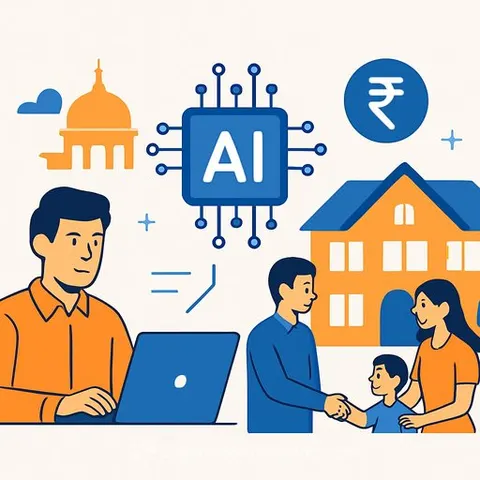
AI Is Reshaping Real Estate Sales and Expanding Markets Beyond Traditional Cities
A developer recently sold more than 1,400 apartments worth ₹640 crore using an AI-powered system, with no physical site visits and no human sales staff involved. The sale signals a fundamental shift in how property moves from developer to buyer.
For decades, real estate sales depended on site visits, sales offices, printed brochures and broker conversations. Buyers spent weekends driving across cities, walking through sample apartments and waiting weeks to decide. That model is beginning to dissolve.
How AI Handles Sales at Scale
Instead of large on-site teams, developers now use digital systems that manage thousands of customer conversations simultaneously. In the case above, the AI system processed more than 45,000 customer interactions, answering questions, identifying patterns in buyer behavior and improving responses based on previous conversations.
Property buying follows predictable patterns. Buyers ask about price, payment plans, approvals, connectivity, future appreciation, nearby infrastructure and possession timelines. When AI analyzes thousands of these conversations together, it identifies what matters most to buyers, where they hesitate and what moves them toward a decision.
This makes the sales process faster and more data-driven than traditional methods.
Lower Costs, Shorter Sales Cycles
Real estate margins are thin and closely watched. When a project needs fewer site teams, fewer sample flats and less physical marketing, operational costs drop meaningfully. That creates room for better margins or better product quality.
Transaction processes are also moving online. Home loan approvals, document verification and digital paperwork no longer require in-person steps. The gap between buyer interest and final booking shrinks.
Human relationships still matter in real estate-it remains a trust-driven purchase. But AI is taking over the repetitive, process-heavy parts of the sales journey.
New Markets Beyond Metro Cities
Technology is not the only force reshaping the sector. Investment is flowing toward new geographies. Cities such as Ayodhya, Varanasi and Vrindavan are emerging as real estate markets, not just pilgrimage destinations.
When a city attracts millions of visitors annually, demand grows for hotels, serviced apartments, retail spaces and second homes. As public infrastructure improves and land supply stays limited, property values often rise. Developers are paying attention.
Why This Matters for Your Margins
In a typical real estate project, land acquisition accounts for 25-30 percent of total cost. Construction takes another 25-30 percent. Sales and distribution typically run 7-9 percent. Well-executed projects generate net margins of 25-30 percent.
Improving sales efficiency directly impacts the bottom line. If technology reduces customer acquisition costs, improves conversions and shortens booking cycles, the financial gain is significant. That is why developers view AI as a business advantage, not just a marketing tool.
A Global Trend
This is not limited to India. Real estate companies worldwide use AI for pricing, site selection, demand forecasting and property valuation. Design firms use generative tools to test building layouts and zoning possibilities before construction begins. Logistics developers use AI to identify high-potential locations based on transport networks and consumer density.
AI helps companies make smarter decisions earlier.
What Changes for Investors
Real estate remains a strong long-term asset class, but the rules are shifting. Markets with infrastructure momentum, strong demand drivers and limited supply will attract increasing attention. Technology is making market discovery, evaluation and transactions more transparent.
Beyond traditional urban housing, new demand is emerging for holiday homes, serviced villas, managed farmland and nature-led second homes. As disposable incomes rise, buyers purchase for lifestyle and utility, not just appreciation. Rental yields in these categories are beginning to stabilize.
For more on how AI is changing sales and operations, see our coverage of AI for Sales and AI for Real Estate & Construction.
The Path Forward
Real estate has always been driven by location. Now it is increasingly shaped by data and intelligence. Over the next few years, the sector will become faster, more digital and more transparent. AI will move beyond chatbots toward systems that identify leads, answer detailed questions, process documents and support transaction closure.
Human judgment and local understanding remain important. The developers who combine those strengths with speed, transparency and technology will lead the next chapter of growth.