3 predictions on how AI will transform CX in 2026
In 2025, big claims flew about AI wiping out customer service jobs. Yet contact centers are still staffed, customers still ask for humans, and regulation in the U.S. is in flux. The tech moved forward, but messy data, weak process design, and rushed rollouts held many teams back.
Here's what customer support leaders should expect in 2026 - and how to prepare.
1) Most brands will use AI for discrete tasks, not full agentic systems
Agentic AI will get attention, but most teams won't be ready to hand off end-to-end workflows, according to Isabelle Zdatny of Qualtrics XM Institute. Expect targeted applications instead: natural language processing for unstructured feedback, predictive models like synthetic NPS to flag churn risk, and faster insights for coaching and QA.
The blocker isn't the model. It's the work underneath: clean data, mapped processes, and clear handoffs. As Zdatny put it, organizations run on undocumented, messy processes - "Susan in procurement has this workaround." If you layer AI on top of that, you amplify dysfunction, you don't fix it. Invest in taxonomy alignment, process mapping, and interaction design (see Design - AI Design Courses) before scaling automation.
- Start small: pick 2-3 tasks with clear ROI (triage, summaries, intent detection, churn prediction).
- Clean the inputs: unify taxonomies, remove duplicates, and set retention rules for training data.
- Map the workflow: who does what, when, and what "done" means. Write the happy path and the fail path.
- Instrument everything: track accuracy, latency, escalation rate, and impact on FCR and CSAT.
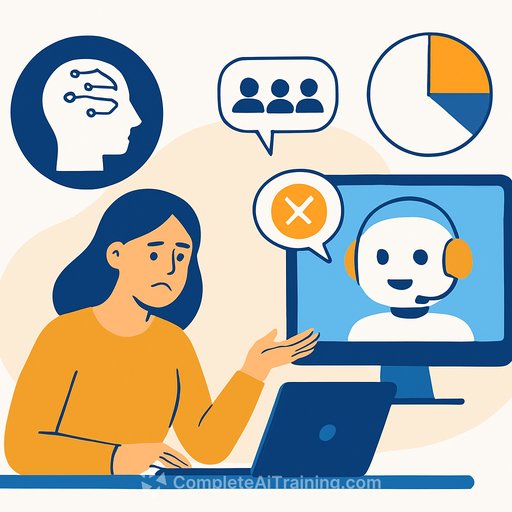
2) Rushed self-service will backfire - expect more failures than wins
Forrester's Max Ball expects about one-third of brands that ship "modern AI" bots to fail. The root cause is familiar: cost pressure. A self-service interaction costs about one-tenth of an agent call, so teams push scope too far, too fast - and customers pay the price with unresolved issues.
AI is ready for the right use cases. Brands aren't ready when data is noisy, flows aren't integrated, and escalation is an afterthought. Even when bots work, over-automation can hurt long-term loyalty if customers can't build real connections with your people.
- Pilot narrow intents first (billing address change, order status, password reset). Prove resolution, then expand.
- Design for graceful failure: fast routing to the right agent with context and transcripts attached.
- Measure what matters: containment quality, not just containment rate. Track FCR, CES, transfer loops, and post-contact CSAT.
- Add a kill switch: turn off or roll back a model within minutes if error rates spike.
- Protect loyalty: keep high-emotion journeys human by default (fraud, cancellations, outages, health and safety).
3) Federal AI directives will speed adoption - and raise CX risk
A new executive order seeks to challenge and replace a patchwork of state AI laws. A single standard lowers friction for businesses and will speed up AI rollouts across pricing, personalization, and agentic actions on a customer's behalf. But loosening state guardrails could raise risks around data use, discrimination, and misleading automation, as noted by Dan Hartman of CSG.
Customers won't blame policy. They'll blame your brand if experiences feel opaque or unfair. The winners will adopt AI faster - and invest in governance, accountability, and intentional limits.
- Stand up an AI governance board with CX, Legal, Security, and Data Science. Publish decision rights and build role-specific capabilities (see AI Learning Path for CIOs).
- Adopt a risk framework (e.g., NIST AI RMF) and run red-team tests before launch.
- Disclose clearly when automation is in play. Offer a human path within two clicks.
- Limit high-stakes automation: pricing, eligibility, and refunds need extra review and audit trails.
- Monitor bias, false denials, and complaint rates by segment. Fix, then scale.
What this means for support leaders
2026 will reward teams that do the unglamorous work. Clean your data. Clarify your workflows. Start narrow. Automate for resolution, not deflection. Keep humans in the moments that actually build loyalty.
90-day action plan
- Week 1-2: Pick 3 use cases with measurable impact (e.g., auto-summarization, intent routing, synthetic NPS).
- Week 3-6: Map processes and data flows. Define success metrics and failure thresholds. Build escalation paths.
- Week 7-10: Launch controlled pilots. Score quality weekly. Capture agent and customer feedback.
- Week 11-12: Patch failure modes, document decisions, and expand scope only if KPIs hold for two cycles.
If you want structured upskilling for your team, explore role-focused programs such as the AI Learning Path for Regulatory Affairs Specialists.
For a quick overview of state activity you may still need to consider in 2026 planning, see this roundup from an authoritative source: NCSL on AI-related legislation.
Your membership also unlocks: