The Promise of AI in Spacecraft Design
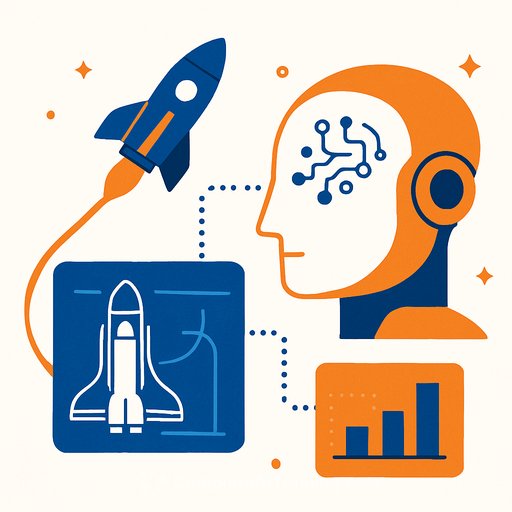
Artificial intelligence holds significant potential to change how spacecraft are designed. From near real-time performance assessments that allow exploring more design options, to generative algorithms producing high-performing variants based on mission needs, AI offers many opportunities. Yet, this area remains relatively new, and engineering teams are cautious, seeking proof of AI’s reliability before adopting it fully.
The challenge isn’t with the AI algorithms themselves—they work. The real issue lies with data. Aerospace and defense manufacturers may have vast amounts of CAD files, simulation results, and test data, but if this data isn’t clean, relevant, or well-structured, AI tools can’t make effective use of it. For many engineers, AI still feels more like hype than a practical solution. To change that, engineers need AI tools that integrate domain expertise with structured data and transparent logic.
It’s Not the Model, It’s the Data
Aerospace engineering involves complex physics. Simulating spacecraft performance—covering orbital dynamics, thermal shielding, and structural loads—requires detailed, high-fidelity models. Today’s AI methods are capable but lack the essential fuel: high-quality, simulation-ready data.
Engineering data differs from typical business data. It’s rarely organized in a way AI can easily use. CAD models built on boundary representations (B-reps) or NURBs don’t translate well for AI. Simulation results often live in isolated folders, linked to specific solvers, and rely on fragile workflows that break under scale. Many aerospace organizations have what looks more like a data swamp than a data lake—and AI can’t learn from that.
Why Spacecraft Design is a Unique Challenge
Spacecraft systems are tightly integrated. Changing one element like mass distribution or thermal dissipation impacts many others. For example, improving thermal performance by increasing surface area can increase drag and affect structural loads. These interdependencies slow down design iterations.
Multiphysics simulations take days to complete and must be rerun after every change. Training machine learning (ML) models on thousands of simulations is nearly impossible without significant automation and computing resources. Even with automation, failures happen—meshing errors, solver crashes, or broken workflows lead to fragmented data. Without a controlled, versioned, and physics-aware workflow, ML can’t produce reliable, usable results. The issue isn’t a lack of AI capability but a lack of usable input data.
Where Engineers are Starting to Break Through
Despite these obstacles, some engineering teams are finding ways to apply ML effectively, especially where simulations are repeatable and speed matters.
- One aerospace company optimized a heat exchanger’s internal geometry using AI. They parameterized the design for easy adjustment and automated over 400 high-fidelity simulations in under eight hours. This clean dataset trained a surrogate model that predicted full velocity and pressure fields quickly. The result: design optimization that once took weeks now happens in minutes.
- In another case, engineers trained a surrogate model to predict aerodynamic performance from parameters like wing sweep and fuselage length. This powered an inverse design loop generating airframe designs in seconds based on goals like maximizing payload for a certain range. Thousands of AI-driven iterations converged on practical designs.
These successes depend on quality data, structured geometry, and transparent logic—not black-box AI. The approach supports certifiable, engineer-in-the-loop design that engineers can trust and control.
How to Know if Your Workflow is ML-Ready
Not every engineering problem benefits from ML. To decide if it’s right for your workflow, ask:
- Does your problem have a strong physics basis? ML builds on physics models rather than replacing them. Problems with well-established physics simulations (fluid dynamics, thermal, structural) generate structured data ideal for ML.
- Is simulation speed a bottleneck? ML shines when it replaces slow, resource-intensive simulations. If your simulations already run quickly, ML may offer limited advantage.
- Do you have the right data or a way to generate it? ML needs clean, consistent data. If your workflow produces reusable simulation results, you’re in a good position. If not, you’ll need to establish a scalable data generation process.
Also, consider if your AI tools produce outputs you can inspect, refine, and manufacture. If you can’t trace results back to your physics model or adjust the design, the tool’s long-term value is limited. Versioned, traceable data tied to physics-based models is essential for trust and certification.
A Blueprint for Getting Started
If your workflow meets these criteria, follow these steps to introduce AI effectively:
- Define a clear prediction goal. Focus on a specific physics-based outcome like lift-to-drag ratio, pressure drop, or thermal resistance. Clear goals help target data collection and modeling.
- Generate quality data at scale. Use modeling approaches that handle broad parameter changes without failure. Automate simulations to run rapidly without manual intervention, preferably with GPU-native solvers that avoid fragile meshing steps.
- Train a stable, accurate model. Choose ML frameworks suited to your physics domain, such as NVIDIA PhysicsNeMo. Prioritize transparency and iterative improvement over one-off accuracy.
- Integrate into your workflow. ML models should fit seamlessly into existing tools so engineers don’t need to become data scientists. Fast, accurate, and accessible predictions encourage adoption.
- Build for traceability and governance. Every design choice should be inspectable, with version-controlled logic and reviewable simulation outputs. The goal is to empower engineers to interact with results, refine inputs, and understand model behavior.
From Hype to Impact
AI in spacecraft design is moving beyond hype. Successful organizations treat simulation data as valuable capital and invest in scalable, well-managed pipelines with clear goals. Without quality data, even the best AI models are just guesses.
Engineering judgment remains central. With the right AI tools, engineers can explore more options, iterate faster, and make better-informed decisions. In space projects where every iteration costs time, mass, and money, speed alone isn’t enough. It’s the combination of defensible speed, traceable logic, simulation-ready geometry, and certifiable outputs that distinguishes effective engineering workflows from empty promises.
Your membership also unlocks: