AI's Impact on the U.S. Workforce: What HR Needs to Know
AI isn't a distant concept. The latest Iceberg Index shows current AI can perform task segments tied to 11.7% of the U.S. labor market-about $1.2 trillion in wage value. That's based on a map of 151 million workers, 32,000 skills, and 923 roles. For HR, this is a clear signal: task design is changing faster than job titles.
Capability over hype
The headline isn't "job losses." It's capability and feasibility. AI can do parts of many jobs at a cost equal to or lower than human effort. Adoption, however, depends on budgets, leadership priorities, legal risk, data access, and culture-so change will land unevenly across companies and functions.
It's not just tech
Tech roles account for 2.2% of wage value (~$211B). But finance, healthcare admin, logistics, HR, and professional services are already using AI for analysis, documentation, and workflow support. AI is moving into routine operations, not just developer toolkits.
Automation isn't adoption
Just because a task can be automated doesn't mean it will be. Full automation can be costly, disruptive, or unwise. Many firms see AI lift both revenue and headcount because they reallocate work rather than remove it. Expect phased change: task redesign first, job redesign later.
Entry-level shock: the data and why it matters to HR
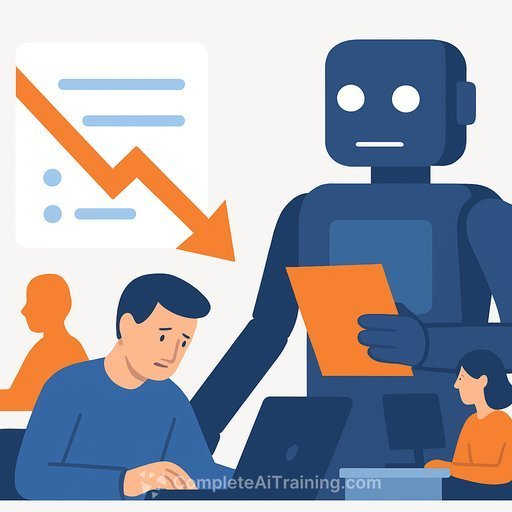
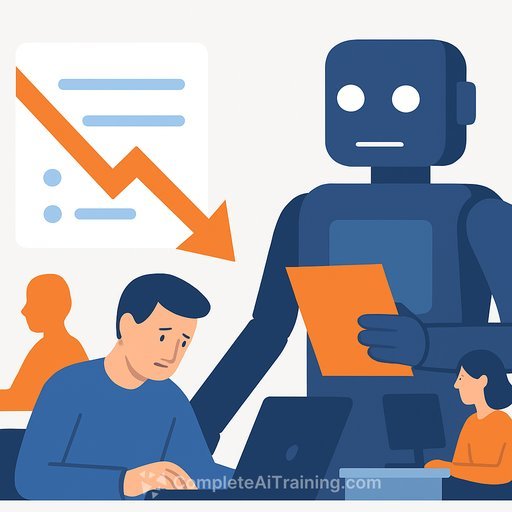
Early-career roles (ages 22-25) in high-AI-exposed jobs show a 13% relative decline in employment. Job postings tilt away from entry-level and toward experienced hires. Why? Early roles are heavy on routine tasks AI is good at, and companies tend to rewire tasks before titles.
This doesn't erase entry-level work. It changes it. HR's challenge is to protect the pipeline while upgrading the work itself.
Action for HR: protect the pipeline while raising the bar
- Rewrite entry roles so 30-50% of time is non-routine: client-facing, problem-solving, analysis, project coordination.
- Stand up apprenticeship-style programs where juniors own outcomes with AI assistance, not just busywork.
- Pair juniors with AI-augmented mentors; set weekly "review and refine" rituals for human-AI outputs.
- Hire for learning speed and communication; test with work samples that include AI tools.
- Convert internships into build-measure-learn sprints with clear deliverables and feedback loops.
Government is moving-talent markets will follow
Policy is leaning in: a federal AI Action Plan with dozens of initiatives and a national AI Workforce Research Hub. The Department of Energy has flagged 16 federal sites for new data centers, and states are investing heavily-North Carolina's $10B for data center capacity; Tennessee's Google-Kairos project; Utah's Operation Gigawatt; Virginia's $1.1B to produce 32,000 AI-skilled graduates; plus $100M for nuclear safety training.
Translation for HR: expect local supply-and-demand swings, competition for specific skill sets, and new compliance needs tied to AI use.
Practical steps for HR this quarter
- Task audit: Break key roles into task inventories. Flag tasks that are rules-based, repetitive, or data-heavy-prime AI candidates.
- Role redesign: Shift time from routine tasks to client interaction, judgment calls, and cross-team problem solving.
- Skills taxonomy: Map current skills to AI-era skills (prompting, QA of AI outputs, data literacy, workflow orchestration).
- Hiring reset: Add AI work samples to interviews. Evaluate candidates on tool fluency and ability to verify and improve AI outputs.
- L&D fast lanes: Launch short, stackable learning paths with weekly practice and on-the-job projects.
- AI governance: Define approved tools, data policies, human-in-the-loop checkpoints, and audit logs for compliance.
- Comp and job architecture: Update job levels to include "AI supervision/integration" responsibilities and career paths.
- Vendor scrutiny: Demand clear ROI, quality metrics, and bias testing from AI vendors; pilot before scaling.
- Change enablement: Train managers to coach human-AI teams; set norms for review, documentation, and escalation.
- Metrics that matter: Track cycle time, quality, error rates, and employee adoption. Tie wins to business outcomes.
Skills that keep roles resilient
- Digital proficiency: Working knowledge of AI tools for summarization, analysis, drafting, and workflow automation.
- Human strengths: Communication, leadership, negotiation, ethics, and critical thinking.
- Ongoing development: Micro-credentials, short courses, and project-based learning to keep pace.
- Domain depth: The more specific the expertise, the harder it is to replace. Pair domain skill with AI fluency.
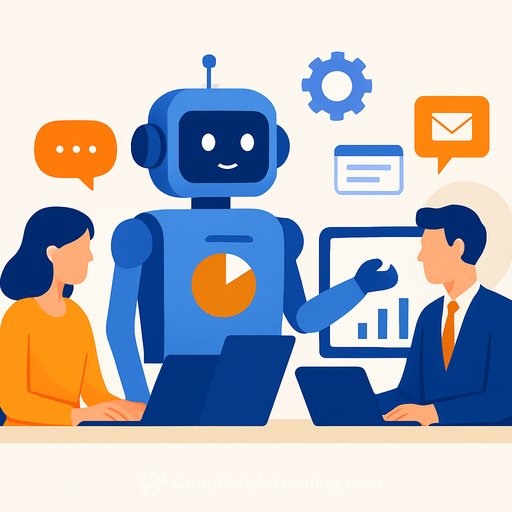
- Human-AI interaction: Set prompts, verify outputs, resolve ambiguity, and integrate results into real decisions.
What this means for HR
AI is changing tasks faster than org charts. The teams that move first on task mapping, role redesign, and skills will set the pace. Protect your entry-level pipeline, raise the quality of work, and make AI a performance multiplier-not a replacement plan.
Get your team fluent
- AI courses by job role to upskill recruiters, HRBPs, and L&D quickly.
- Latest AI courses for hands-on practice and micro-credentials.
Your membership also unlocks: