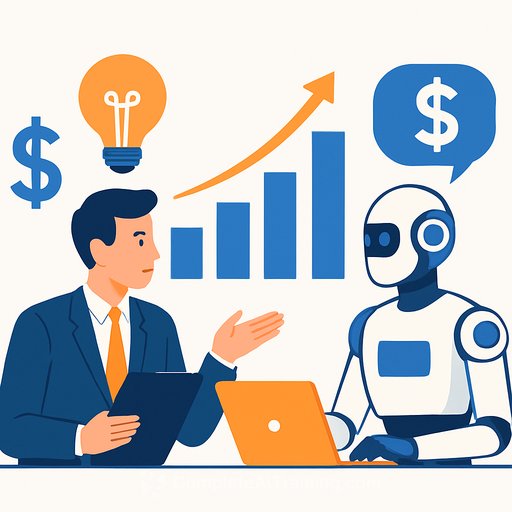
AI vs. Human Advisors: What Managers Need to Do Before the Market Decides for Them
After 34 years in the business, Kevin S. Gray is making a simple bet: AI will manage money better than humans by removing emotion. His stance, shared in a recent Fox Business piece, is blunt-emotional decisions destroy wealth, and algorithms don't panic or chase hype.
If you lead teams, budgets, or strategy, this isn't theory. It's an operations problem. The firms that codify discipline into software will capture gains that others leak through behavior.
Why AI has the edge
Behavioral drag is real. Studies Gray references suggest investors trail benchmarks by 1.5% to 4% annually thanks to fear, FOMO, and poor timing. AI follows rules you set in calm moments-dollar-cost averaging, rebalancing, and tax-loss harvesting-especially when markets are messy.
Robo-advisors aren't basic anymore. They use machine learning for risk profiling and portfolio selection, often charging around 0.15% instead of the 1% (or more) you see with traditional advisors. That fee gap alone is an annual head start before returns even show up.
What the market is signaling
- Platforms like Betterment and Wealthfront already manage billions with automated portfolios.
- Vanguard reports AI is strong at routine tasks-rebalancing, tax-loss harvesting-freeing humans for complex client needs. See Vanguard insights.
- A World Economic Forum analysis flags consistency as AI's advantage, while asking the right question: can machines earn trust over time? WEF coverage.
- Forbes Advisor UK highlights robo-advisors handling volatility with algorithm-driven personalization.
- Wealthfront's 2025 disclosures cite periods where returns beat the S&P 500 during volatility.
- Microsoft forecasts agentic AI-autonomous systems that handle client requests-shifting services by 2026.
- Banking forecasts point to synthetic data improving predictions and testing.
Regulation and adoption
The SEC is watching AI for transparency and fiduciary duty. Expect explainability and audit trails to become non-negotiable. That's not a blocker-it's a design constraint.
Meanwhile, adoption surges. Reports show AI spend in financial services pushing toward $100B by 2027. The signal: budgets are moving ahead of sentiment.
Where humans still matter-right now
Not everyone agrees with a pure AI future. A top-ranked advisor told CNBC that relying on AI can miss the personal and emotional side of money. Universities and industry groups also point to hybrid models: let AI handle the math, and people handle nuance-estate goals, tax context, life events.
Even Gray-who sees AI taking the lead-uses it today as an engine under human oversight. The line is shifting, but not gone.
Your playbook for the next 12-24 months
- Codify your rules. Identify where emotion hurts decisions (sell discipline, rebalancing bands, buy triggers). Turn these into policies the system enforces without debate.
- Run a controlled pilot. Stand up an AI overlay or robo pilot for a segment. Track tracking error, after-tax returns, drawdown behavior, and cash drag.
- Automate the obvious. Dollar-cost averaging, tax-loss harvesting, rebalancing, and cash sweeps should be on autopilot with clear thresholds.
- Demand explainability. Require model documentation, scenario tests, and override logs. Tie every recommendation to fiduciary standards.
- Upskill the team. Train staff on prompts, data checks, and exception handling so they can supervise AI at scale; consider AI Design Courses for practical, design-focused training. If you need a shortcut, explore practical finance tool stacks here: AI tools for finance.
- Rewire client communication. Set expectations for how AI runs day-to-day, when humans step in, and what "discipline" means under stress.
- Tighten vendor due diligence. Look for SOC 2, strong data controls, auditability, and SEC-ready reporting. Compare all-in costs to your current AUM fees.
- Measure what matters. Net-of-fee returns, tax alpha, behavioral gap closed, hours saved per client, and time-to-implement changes.
Performance signals to watch
Fees: 0.15% vs 1% compounds into real money. Behavior: fewer panic moves and better cash utilization show up in your numbers. Risk-adjusted returns: look at Sharpe and drawdowns in volatile windows, not just headline gains.
If you're comparing options, run them through the same stress tests your risk team uses-and force consistency over a full cycle.
What Gray's bet means for leaders
"Emotional decision-making destroys wealth." That's the thesis. Structured algorithms, run 24/7 without fatigue or bias, are more reliable than human mood swings-especially during selloffs.
You don't have to rip out human advice. But you do need to move the heavy lifting to systems that don't blink. The firms that systematize discipline will protect capital and client trust when it counts.
Bottom line
AI is gaining ground on cost, consistency, and speed. Human advisors still matter for context and empathy, but the core portfolio engine is becoming software. Gray's call is a warning and an opportunity: build the hybrid now, or watch pure AI models set the standard without you.
Your membership also unlocks: