
AI news ·
AI Is Recasting Work in France: Early Jitters, Quiet Hiring Freezes, and a Squeeze on Junior Roles
AI is changing France's job market, slowing some hires while boosting demand for AI roles. HR needs a plan: map tasks, add oversight, protect juniors, reskill, and set guardrails.
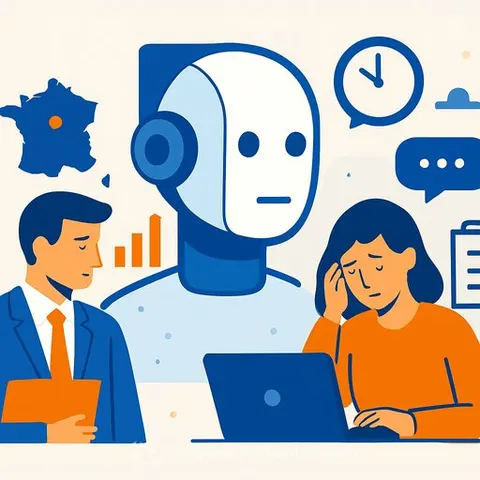
AI is reshaping France's job market - here's the HR playbook for early days
Amazon's plan to cut 14,000 jobs sent a clear signal: AI is now a material factor in workforce decisions. The United States is already deep into restructuring and hiring slowdowns. In France, the impact is harder to see, but the indicators are pointing in the same direction. HR leaders don't need to panic - but they do need a plan.
What's changing right now
In under three years, tools like ChatGPT have moved from curiosity to daily workflow. The World Economic Forum's Future of Jobs 2025 highlights faster automation of administrative functions across banking, insurance, communications, marketing, logistics, and data analysis. Repetitive and predictable tasks are getting picked off first.
Translation is the cautionary case. "I feel like I have a sword of Damocles hanging over my head," says Fanny, a freelance translator of 15 years. Machine translation has created a new role - the "post-editor" - lower paid, less interesting, and faster turnaround. Duolingo cut 10 percent of freelance translators in 2024 and later trimmed authors, stating a shift to AI-generated content.
Big companies are moving. Amazon linked cuts to generative AI - "the most transformative technology we've seen since the internet," said Beth Galetti, VP of HR. IBM automated parts of HR. Accenture let go 12,000, Salesforce 4,000. Microsoft reduced 200 roles in France under a global efficiency plan tied to AI investment. Klarna leaned hard into AI in marketing and support, then rehired after customer backlash. The pattern: fast adoption, followed by course correction when quality slips.
France: signal through the noise
Europe is cautious. No large-scale social plan in France has been explicitly attributed to AI yet, but momentum is building. Antonin Bergeaud (HEC) expects similar consequences to the US: slower recruitment in high-risk roles while companies test the tech.
A late-September LHH study shows 46% of executives have already reduced headcount because of AI, and 54% plan to employ fewer people within five years. Only 12% of affected employees see AI as the reason for their exit - a communication gap. At the same time, PwC reports a 273% surge in AI-related job postings in France between 2019 and 2024. Early productivity gains can trigger more hiring in select areas, even as other roles freeze. Most of this is happening in large firms with a defined AI strategy.
Junior roles are under pressure
Internships and entry-level roles are the first to shrink. HEC Talents notes fewer traditional junior positions as analysis, synthesis, and report creation are automated. New hires are now expected to supervise and validate AI output. That raises a dilemma for employers: how do you build senior talent if you reduce junior intakes?
US data backs the trend. A Stanford study found a 13% drop in employment for 22-25 year-olds in the most exposed professions since generative AI went mainstream, and up to 20% for developers since late 2022. Recruiter Greg Lhotellier argues macroeconomics is doing most of the damage, but expects a shift toward "AI manager" roles - people who control, arbitrate, and genuinely understand what the systems are doing.
What HR should do now
- Map tasks, not just jobs. Identify repeatable workflows in each role that are candidates for automation, augmentation, or redesign.
- Redesign roles to include AI oversight. Add responsibilities like prompt QA, fact-checking, compliance checks, and exception handling.
- Protect the junior pipeline. Replace "grunt work" with structured rotations, apprenticeships, and supervised projects so learning still happens.
- Create new entry points. Build "AI-assistant plus" roles where juniors learn by supervising systems, not just doing busywork.
- Stand up reskilling paths. Move people in at-risk roles (translation, support, basic analysis) into post-editing, QA, data stewardship, or domain-expert reviewer tracks.
- Set a baseline for AI literacy. Train for prompt quality, verification, privacy, and bias. Issue internal certifications for managers and individual contributors.
- Establish guardrails. Human-in-the-loop by default, audit trails, policy on data use, and clear escalation for model failures.
- Balance quality with savings. Klarna's reversal shows customer experience is the constraint. Pilot, measure, then scale.
- Track productivity redeployment. Don't let "time saved" turn into idle time - reassign to revenue, quality, or innovation goals.
- Communicate early and plainly. Explain where AI replaces tasks, where it augments, and how people can progress.
Hiring and compensation implications
Expect demand for roles like post-editors, AI trainers, prompt QA, AI product ops, and AI managers. Update job architectures and pay bands to reflect oversight and judgment work, not just production. Build internal mobility from adjacent roles rather than overpaying in a tight external market.
Career ladders need a rethink. If fewer entry-level tasks exist, create milestones based on verified capability (project complexity, QA accuracy, incident resolution) instead of years of tenure.
Metrics to watch
- Share of roles with defined AI use cases and guardrails
- Junior-to-senior ratio by function
- Hiring latency in high-exposure roles
- Training completion and proficiency rates
- Quality metrics post-AI (error rates, rework, customer satisfaction)
- Internal transfers from at-risk roles to AI-adjacent roles
- Percent of "time saved" that's redeployed to priority outcomes
Research and references
For context on task exposure, see the International Labour Organization's analysis of generative AI and jobs. For hiring signals and wage trends, review the PwC AI Jobs Barometer. Both provide useful baselines when building your workforce plan.
Upskill your managers and teams
If you need a fast way to build AI literacy by role, explore curated training paths by job family. It's a practical way to standardize skills and move people into higher-value work.