
AI news ·
AI job rejections feel least fair when avatars share one trait with applicants
A 220-person study found AI rejections feel most unfair when applicants share one trait with the avatar. Matching gender or skin color causes more bias than sharing both or none.
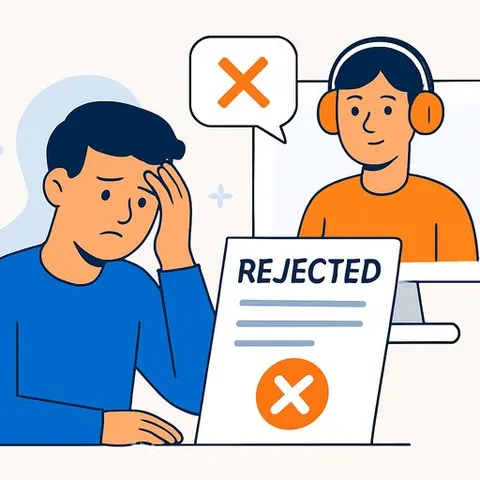
Job applicants who are rejected by an AI interviewer perceive the decision as most unfair when they share just one demographic trait with the avatar that delivered the news-either gender or skin color-according to a study published in the Proceedings of the 2026 CHI Conference on Human Factors in Computing Systems. The finding complicates the assumption that AI-driven hiring is either uniformly accepted or rejected, and it arrives as companies expand their use of automated interview tools to save time and reduce human bias.
Researchers from the Technical University of Munich and Lund University recruited roughly 220 participants from Germany, the United Kingdom, and the United States to complete a simulated job interview for a fictional customer support role. Each participant faced a photorealistic avatar that could react to answers and ask follow-up questions. The team programmed four avatar variants: female or male, with either dark or light skin. Eye-tracking hardware recorded where participants looked during the interaction, and a questionnaire captured their reactions after they received a rejection.
How the study worked
Before the rejection, trust in the AI system was consistently high regardless of whether the participant and avatar matched on gender or skin color. Eye-tracking data showed one notable difference: participants spent more time looking at the avatar's face when its skin color differed from their own, as self-reported.
That dynamic shifted after all applicants were told they had been turned down for the position. When the avatar's skin color differed from the participant's, people were more likely to attribute the rejection to bias. However, the strongest sense of unfairness surfaced among those who matched the avatar on exactly one characteristic-either gender or skin color. These participants rated the decision as less fair than those who matched on both traits, and also less fair than those who matched on neither.
When one shared trait feels worse than none
"What has been largely overlooked so far is that we all unconsciously react to the avatars' appearance, even when we know we're talking to a machine. That's why a conversation with artificial intelligence becomes a social interaction as soon as it behaves like a human," said Enkelejda Kasneci, professor of Human-Centered Technologies for Learning at TUM.
The partial-match effect suggests that perceptions of AI fairness do not follow a simple in-group versus out-group pattern. Instead, sharing a single visible trait with a decision-making avatar may trigger a sharper sense of betrayal when the outcome is negative-possibly because the expectation of favorable treatment is partially primed but then violated.
The social side of AI design
As companies adopt AI for Human Resources, the study highlights a gap between technical fairness and perceived fairness. Kasneci pointed out that even a model trained to be unbiased can still be seen as unfair for reasons rooted in social behavior. "The discussion about fairness in the use of artificial intelligence has so far revolved mainly around whether the models are programmed and trained without bias. But even if that is the case, AI may still be perceived as unfair. And this effect can arise for reasons other than what we might assume at first glance," she said.
The results suggest that avatar design choices-such as skin tone and gender presentation-carry weight even when applicants know they are interacting with a machine. Eye-tracking data confirmed that people process these visual cues differently depending on their own identity, and that those cues can shape post-decision reactions in ways that are not immediately intuitive.
Why this matters for HR professionals
For HR teams evaluating or deploying AI interview tools, the study offers a concrete warning: the appearance of an interviewing avatar can influence whether rejected candidates believe the process was fair. A candidate who shares only one visible trait with the avatar may walk away with a stronger sense of bias than someone who shares none. This means that even well-intentioned efforts to make avatars relatable could backfire in unexpected ways.
HR managers who want to better understand these dynamics can explore an AI Learning Path for HR Managers that covers recruitment automation and workforce analytics. The key takeaway is that fairness in AI hiring cannot be reduced to algorithm audits alone. The design of the interface-and the social signals it sends-needs the same scrutiny as the code behind it.