AI can now pass the CFA exams: what that means for finance jobs
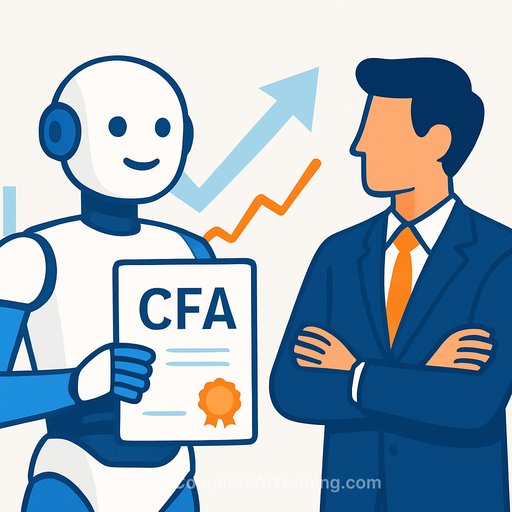
Six leading AI models have reportedly cleared all three levels of the CFA exams. Scores were high across the board, with Gemini 3.0 Pro hitting 97.6% on Level I and GPT-5 leading Level II at 94.3%. Even the constructed-response section, historically tough for machines, saw credible performance.
Passing exams isn't the same as stewarding capital. But this does mark a threshold: AI can now handle structured, high-stakes financial reasoning tasks that used to be out of reach.
What changed under the hood
New models are better at multi-step reasoning. They connect ideas across long case studies, track conditions, and apply rules instead of parroting formulas.
Quant performance also jumped. Math-heavy topics that tripped up earlier systems now show near-zero error rates for top models. Ethics remains a weak spot, with nuanced judgement still causing mistakes.
Why this matters on a finance desk
Think of these models as tireless junior analysts. They can draft investment memos, parse filings, summarize earnings calls, stress-test a thesis with alternative scenarios, and surface red flags.
They speed up the grunt work. You keep the accountability: judgement, risk calls, portfolio construction, and client trust still sit with humans.
Where AI still falls short
Ethical and professional standards remain tricky. Models can state the rules but misapply them in context-heavy scenarios. That's dangerous if you accept outputs at face value.
Constructed responses are also hard to score fairly with automated graders. Longer, cleaner answers can get over-credited even when they hide subtle errors. Human review is non-negotiable.
Practical playbook for teams
- Define "AI-safe" tasks: data extraction, first-draft summaries, what-if checks, KPI reconciliation, and literature reviews.
- Require sources for any factual claim. Prefer outputs with citations and clear assumptions.
- Add an ethics pass: build a checklist aligned to the CFA Code and Standards, and review any recommendation that touches client suitability, conflicts, or disclosures.
- Backtest prompts on historical cases. Measure precision/recall by topic (accounting, fixed income, derivatives, ethics).
- Gate access to client data. Log prompts and outputs for audit and model-risk oversight.
- Establish human-in-the-loop signoffs for anything that leaves the building: notes, ratings, portfolio changes, client emails.
- Run periodic "red team" sessions focused on edge cases: ambiguous ethics, unusual accounting treatments, regime shifts.
Implications for roles and hiring
- Entry-level work shrinks; oversight and synthesis grow. Fewer hours building the model, more hours questioning it.
- Demand rises for analysts who can interrogate AI, spot flawed assumptions, and tie outputs to fundamentals and risk.
- Process discipline becomes a skill: documentation, data lineage, and exception handling will matter for regulators.
What this does not mean
AI passing an exam does not equal money management. It can't own a P&L, meet clients, or take responsibility for a bad call.
Treat the model like an intern who is fast, tireless, and occasionally wrong in high-stakes ways-especially on ethics and nuanced judgement.
How to prepare (as an individual)
- Pair your domain edge with AI fluency: learn prompt patterns for financial analysis, request assumptions, and force scenario checks.
- Build a personal library of prompts and review checklists for your asset class or sector coverage.
- Stay sharp on the CFA Code and Standards and use it as your final gate. A short refresher is worth it: CFA Institute ethics and standards.
- Explore tools that speed research, modeling, and reporting. A curated starting point: AI tools for finance.
Bottom line
The signal is clear: AI can clear the CFA hurdle. The edge now shifts to professionals who combine model speed with human judgement, compliance-grade process, and client sense.
Use the machines to go faster. Keep the decisions-and the accountability-yours.
Your membership also unlocks: