
AI news ·
AI Literacy Is Australia's Most In-Demand Skill-Teachers Are Leading the Way
AI literacy is now essential in Australian schools, with demand up and teachers putting it to work. Build skills, keep it human, set clear policy, pilots, and privacy-safe tools.
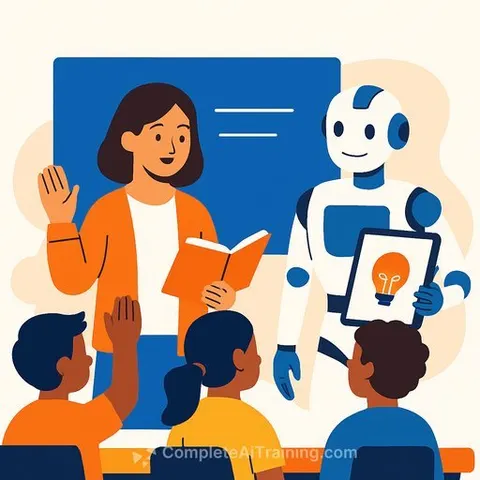
AI literacy is now a must-have for Australian schools
AI is moving fast through every sector. UNESCO says AI literacy is now essential in education, and the hiring market backs it up. LinkedIn's 2025 Skills on the Rise report lists AI literacy as Australia's most in-demand skill, with a 240% surge in AI-related hires since 2016. Add soft skills like communication, strategic thinking, and adaptability, and the brief is clear: students need both technical fluency and strong human judgment.
There's good news. Australian teachers are already ahead of the curve. The OECD's TALIS survey shows 66% of lower secondary teachers in Australia used AI in the past year-fourth highest in the OECD and well above the 36% OECD average. That's momentum schools can build on.
How Australian teachers are using AI
Most teachers who use AI lean on it for brainstorming lesson plans and summarising content-71% reported doing this. Far fewer use AI to review student performance data (9% vs 28% OECD) or assess student work (15% vs 30% OECD). Planning is comfortable; assessment and analytics still feel sensitive.
Educators are positive yet cautious. Privacy, professional judgment, and workload matter. As one education leader put it: teachers are out front with AI use, but wellbeing and quality of work must remain a national priority.
Can AI improve learning-without losing the human factor?
Yes-if teachers are AI-literate, ethical, and creative in how they plan, teach, and assess. Data-literate teachers can track learning over time, see patterns, and act on what students need next. Longitudinal monitoring and Individual Digital Learning Histories can sharpen support. The rule: keep it human-centred.
A practical roadmap for schools
- For school leaders
- Adopt an AI literacy framework aligned to your curriculum. Define acceptable use, privacy, and academic integrity.
- Invest in PD beyond tool demos: prompt quality, data literacy, assessment moderation with AI, and bias awareness.
- Run small pilots in feedback and formative assessment. Track impact on workload and learning outcomes.
- Provide compliant, secure tools. Vet vendors for data protection and offer single sign-on for ease and safety.
- For teachers
- Use AI to adapt resources, differentiate tasks, and co-create rubrics and exemplars. Always apply professional judgment.
- Start with low-stakes uses: question banks, exit tickets, and draft feedback aligned to your criteria.
- Explore analytics carefully: use anonymised data, check patterns against your own evidence, and watch for bias.
- Teach AI literacy explicitly: capabilities, limits, bias, citation, and responsible use.
- For students
- Make AI a tool within projects, not the author. Require process notes and prompt logs to assess thinking, not just output.
- Build portfolios showing iterations, feedback, and final work. Value communication, strategic thinking, and adaptability alongside tool use.
Tool starter kit (simple and effective)
You don't need an IT degree. Focus on three pillars: technical basics, practical use, and ethical awareness.
- Text: ChatGPT (OpenAI), Gemini (Google), Copilot (Microsoft)
- Images: Midjourney, DALL.E (OpenAI), Stable Diffusion
- Practice: Write clear prompts, iterate, compare outputs, and read platform docs and short tutorials.
- Ethics: Get consent, protect privacy, check for bias, and keep a human in the loop for decisions.
Assessment and data use-do it right
- Start with feedback. Use AI to draft comments, then personalise to the student and the criteria.
- For marking support, double-mark a sample to calibrate and set thresholds for when human review is mandatory.
- With learning analytics, anonymise data, validate with other sources, and avoid single-metric judgments.
- Be transparent. Document how AI is used and keep parents informed.
Quick wins for the next 90 days
- Pick two use cases: lesson planning and feedback drafting. Measure time saved and quality gains.
- Run a short staff session on prompt quality and privacy. Share a one-page reference.
- Pilot a formative assessment using AI-generated rubrics and exemplars. Collect student and teacher feedback.
- Draft an AI use policy and invite community input before scaling.
Professional learning you can act on
Want structured pathways? Explore curated AI learning mapped to education roles.