
AI news ·
AI makes research easier but rewards shortcuts over thinking, columnist argues
AI tools have cut research and drafting time from hours to minutes, but creatives who skip the verification step often submit invented citations and hollow work. The skill gap shows when no one brings actual judgment to the output.
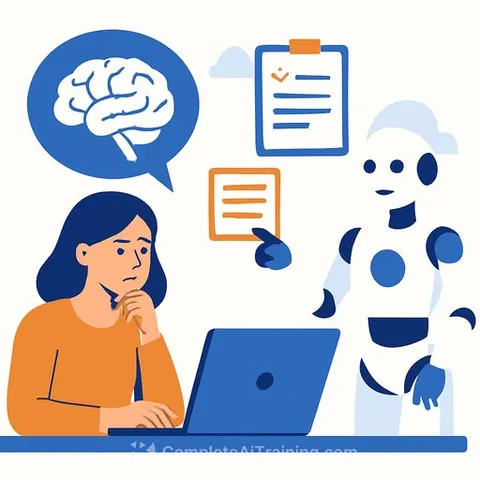
AI has changed how creatives work-and what counts as their own work
Free AI tools have fundamentally altered the speed at which writers, designers, and other creatives produce work. What once required hours of research, planning, and drafting now takes minutes. The shift has created a practical problem: how to use these tools without losing the skill and judgment that made the work valuable in the first place.
The efficiency gains are real. A writer researching an article can ask an AI system a broad question, then refine it repeatedly to find exactly what they need-faster than trawling through archives or journal databases. A designer planning a project can use AI to explore color palettes, typography choices, or layout concepts. A copywriter can test different tones and vocabularies before settling on a final approach.
But speed has a cost. Students and professionals increasingly use AI to generate first drafts, then add surface-level changes-a typo here, a paragraph moved there-to make the output look original. Teachers and judges catch these submissions when they check references, many of which AI invents entirely. The embarrassment is mutual: the user failed to verify, and the AI failed silently.
The skill problem runs deeper
The more subtle issue is whether the person using AI has bothered to bring their own judgment to the problem at all. A student can load assigned readings into an AI system, ask it to answer the assignment question, then submit the result with minor edits. They may pass. They almost certainly learned nothing about the subject.
This matters because the tools are genuinely useful when someone knows what they're doing. A writer with subject expertise can use AI to accelerate research and catch gaps in their thinking. A designer can use it to explore directions they wouldn't have considered alone. The tool amplifies skill; it doesn't replace it.
The problem emerges when creatives treat AI as a substitute for thinking rather than a tool that requires thinking. Asking the right question-and then asking better questions based on the answers-demands clarity about what you actually need. That's prompt engineering in practice, and it's a skill worth developing.
What hasn't changed
The work of checking, refining, and making judgment calls still falls to the human. An AI system can produce a draft in seconds. Verifying its claims, catching its hallucinations, and deciding whether the output actually solves the problem takes time and expertise.
For creatives working under deadline pressure, the temptation to skip these steps is obvious. The pressure is real. But the shortcut costs more than it saves-in credibility, in learning, and in the quality of work that lasts beyond today's deadline.
Those who use these tools effectively treat them as research assistants and brainstorming partners, not ghostwriters. They ask questions, evaluate answers, push back on weak reasoning, and bring their own perspective to the final work. The AI handles the heavy lifting of information retrieval and initial drafting. The human handles everything that matters.
For creatives serious about their craft, that distinction is worth maintaining. Tools like ChatGPT are most useful when they augment your thinking, not replace it.