
AI news ·
AI model helps some patients get diagnoses after years of unexplained illness, study finds
An AI model diagnosed 18 pediatric patients whose conditions had stumped doctors for years, according to a New England Journal of Medicine study. Over 30 million Americans-half of them children-have a rare disease, and many wait years for answers.
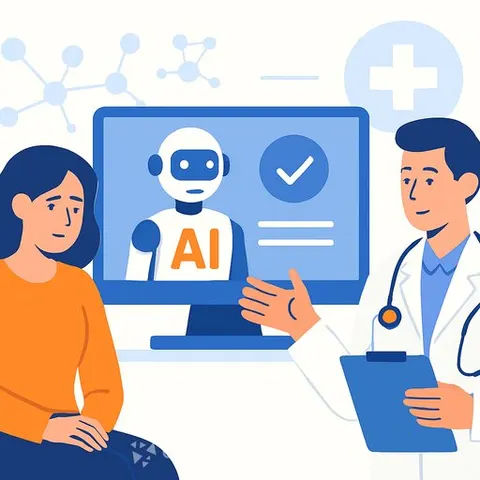
A newly developed AI model has helped diagnose 18 pediatric patients whose conditions had stumped doctors for years, according to a study published Thursday in the New England Journal of Medicine. Researchers from OpenAI and Boston Children's Hospital fed existing genetic data through the model, cracking cases that left some patients without answers for nearly two decades. The work targets a vast and persistent problem: more than 30 million Americans - half of them children - have a rare disease, and many wait years for a diagnosis.
The study does not suggest AI can replace physicians. The model proposed possible answers, but specialists made the final call, and every diagnosis was confirmed by a certified clinical lab before families were told. "We're not removing any human guardrails here," said Catherine Brownstein, a lead researcher and research associate in the division of genetics and genomics at Boston Children's Hospital. "A human has to review everything that the AI does."
Two decades of uncertainty, resolved in minutes
For 28-year-old Kyra, one of the patients in the study, the diagnosis of Myofibrillar Myopathy (MFM) ended a search that began when she was a child. MFM is a group of genetic disorders that causes progressive muscle weakness. Only about 60 cases have ever been published, according to CureMFM13, a charitable organization focused on the disease.
"It felt very surreal at the time because I just didn't expect to get an answer in my lifetime, and I think my family didn't expect it either," Kyra said. Even though the condition has no cure, she added, "we finally got that clarity and closure. At the very least it's nice to have a name."
AI as an extra set of eyes, not a replacement
The model acted as a high-speed filter, helping specialists sift through complex genomic data in roughly six to 10 minutes per case. Brownstein said that by using AI, "we can apply our human time to more specific things, like reviewing the data, rather than going down rabbit holes chasing things that might be possibilities for a diagnosis."
Researchers stressed that AI tools can still make mistakes and misread information. Kyra echoed that caution. "I think for the purpose of assisting researchers in their efforts, especially when they're so complicated and complex, like this situation in this study, I think it can be a very useful tool," she said. "But at the same time, I think we do have to be very cautious."
Why old genetic tests may be worth a second look
The study highlights a practical, often overlooked point: genetic science moves fast. A test result that made no sense years ago may become clear as researchers discover new genes and improve how they search genomic data. "A negative genetic test that's negative right now might not be negative in the future," Brownstein said.
Rechecking old unsolved cases is labor-intensive for clinicians. The rapid pace of discovery makes it hard to keep up. "The genome is being decoded more every day," Brownstein said. "But AI is really, really good at that."
Limits of the study and what comes next
The team acknowledged several constraints. The study looked back at existing cases, so it cannot prove the tool would perform the same way in real time. The number of new diagnoses was small, and researchers did not measure whether the AI saved time, lowered costs, or changed patients' care. The authors wrote that the next step is to test the approach in larger, forward-looking studies across multiple medical centers.
Privacy protections remain central to the technology's design. Brownstein emphasized that no human oversight is being removed. "A human has to review everything that the AI does," she repeated.
Why this matters for science and research professionals
The study signals a shift in how AI models can assist with rare disease diagnosis - not by replacing clinical judgment, but by compressing the time it takes to surface plausible genetic leads. For researchers and clinicians working with genomic data, the bottleneck has long been the manual, case-by-case review of vast datasets. This model shows that AI for Science & Research can function as a triage layer, flagging candidate variants fast enough to make reanalysis of old cases practical at scale. The real test will be whether that speed holds up in prospective studies and translates into measurable changes in patient care.