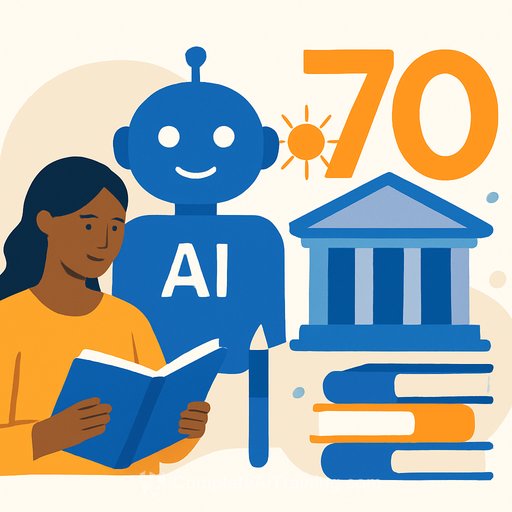
AI opens a new chapter in library management
Chief Adviser Professor Muhammad Yunus signaled a clear direction: AI is ready to make libraries more modern, efficient and user-friendly. As the Library Association of Bangladesh (LAB) marks its 70th anniversary, the focus is squarely on practical adoption-where AI improves information organization, preservation, retrieval and use.
He noted the international conference, "LAB International Conference on Reimagining Librarianship: Forging the Future with AI Technologies," set for December 12-13, 2025. The aim is straightforward: bring professionals, researchers and experts together to turn possibilities into working systems.
Why this matters for management
Library leaders are under pressure to do more with tighter budgets and higher user expectations. AI helps reduce processing costs, surface better insights from data and deliver faster service without compromising quality or ethics.
The opportunity is practical: cut manual workload, improve patron satisfaction, and guide smarter resource allocation with measurable outcomes.
Where AI fits-high-impact use cases
- Information organization: Automated cataloging, metadata enrichment, entity recognition, deduplication and authority control-reducing backlog and improving search precision.
- Knowledge preservation: OCR for digitization, transcription, format migration, anomaly detection for file integrity, and prioritization models for fragile collections.
- Retrieval and use: Semantic search, multilingual Q&A, recommender systems, chat assistants for reference, and accessibility features like text-to-speech and summaries.
- Operations: Demand forecasting for collection development, usage analytics, weeding decisions, space planning, event scheduling and staff workload balancing.
90-day action plan
- Pick two workflows with clear pain points (e.g., cataloging backlog and reference queries). Define success metrics: turnaround time, accuracy, satisfaction scores.
- Pilot a cataloging assistant on a slice of records. Track error rates and time saved versus manual processing.
- Launch a reference chatbot for FAQs and after-hours questions. Escalate complex queries to staff with full transcripts for review.
- Start a digitization + OCR pipeline for high-demand items. Measure retrievals and user engagement post-launch.
- Stand up a data dashboard (loans, holds, search queries, footfall). Use it weekly to adjust purchasing and programming.
- Publish a short AI use policy covering privacy, model limitations and user consent. Keep it visible and update quarterly.
Governance: keep it safe, fair and reliable
- Privacy by default: Avoid sending patron data to third-party tools unless contractually protected; anonymize logs.
- Bias checks: Test search and recommendations across languages, authors and subjects; monitor for drift.
- Accuracy controls: Use human review for cataloging, citations and preservation decisions; log corrections for model tuning.
- Vendor due diligence: Demand clarity on data usage, model retraining, uptime, exit options and total cost of ownership.
- Change management: Train staff, co-design workflows and communicate what AI will and will not do; celebrate time saved and service gains.
Budget and ROI signals
Start small: pilots often run on existing infrastructure or low-cost SaaS. The returns show up as fewer hours per task, faster user response and smarter collection decisions.
Track three core metrics: cycle time per record or request, staff hours saved per month and user satisfaction (CSAT/NPS). Reinvest saved hours into high-touch services and digital programs.
The LAB conference: turning intent into action
With leaders, practitioners and experts in one room on December 12-13, use the event to set a one-year roadmap. Capture case studies, shortlist two vendors, and set dates for pilots and staff training.
As Professor Yunus emphasized, progress depends on the proper and positive application of AI. The mandate for managers is clear: make it useful, measurable and ethical.
Helpful resources
- UNESCO: Recommendation on the Ethics of AI
- IFLA: AI Special Interest Group
- Complete AI Training: courses by job
Your membership also unlocks: