
AI news ·
AI-powered video telematics replaces GPS for fleet safety, says LightMetrics CEO
Fleet operators are shifting from GPS-only tracking to AI video telematics that detect distracted driving and risky behavior in real time. The camera often exonerates drivers.
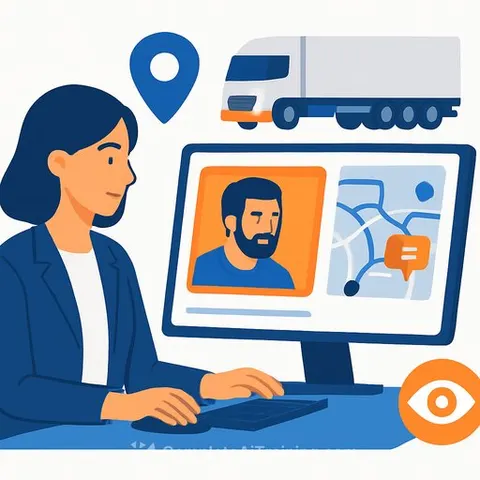
Fleet operators are moving beyond GPS-only tracking toward AI-powered video telematics that can detect distracted driving, fatigue, and risky behavior in real time - a shift driven by rising accident costs, insurance disputes, and the need for evidence that explains what happened on the road, not just where a vehicle was.
Soumik Ukil, Co-Founder and CEO of LightMetrics, said the technology addresses what he calls a "context gap" that location data alone cannot fill. "GPS answered the question of where. It gave fleet operators valuable visibility into vehicle locations, route adherence, and arrival times," Ukil said. "But the problems that cost fleets the most - accidents, disputed insurance claims, driver attrition, and liability - are not location problems; they are context problems."
The shift has implications for how operations teams manage safety, compliance, and driver retention across commercial fleets. For companies already investing in AI for Operations, video telematics represents a new layer of real-time decision support rather than simply another data source.
From location to context: what video intelligence captures that GPS cannot
Ukil pointed out that cameras have been installed in commercial vehicles for years. The breakthrough is the AI layered on top - the ability to understand, classify, and surface what actually occurred in a way that safety managers and coaches can act on. That distinction, he said, gives operators "access to an entirely new category of operational insight that simply didn't exist before."
The system processes questions GPS was never designed to answer: What happened in the three seconds before impact? Was a hard-braking event a risky maneuver or the correct response to an obstacle? Did another vehicle suddenly change lanes? These answers carry weight in accident investigations, driver coaching sessions, and insurance claims.
The trust problem: fewer alerts, better signal
Early generations of video telematics focused on generating more alerts, more event types, and more triggers. The result, according to Ukil, was that fleet managers ended up "drinking from a firehose of information, making it increasingly difficult to distinguish genuine safety risks from noise."
He argued that trust eroded because the technology "too often cried wolf." LightMetrics positions itself in what Ukil calls the third generation of the industry, where models filter aggressively, perform triaging at the edge, and show safety managers only incidents that require attention. "Trust is not a by-product of AI; it is the outcome of AI delivering consistently relevant insights," he said.
The operational takeaway is practical: an alert without a response protocol is simply more data. A coaching conversation that never happens because the safety manager is already managing hundreds of other priorities represents a missed opportunity, regardless of how accurate the AI model may be. For transportation managers building or refining their tech stack, an AI Learning Path for Transportation Managers can help teams connect detection capabilities to actual workflow changes.
Privacy as a design choice, not an afterthought
Ukil pushed back on framing the debate as surveillance versus safety, calling it "a false and unhelpful choice." The real questions, he said, center on what philosophy governs deployment, what data is retained, who has access to it, and for whose benefit it is ultimately used.
LightMetrics advocates for incident-triggered recording rather than continuous capture, transparent access policies, and clear communication with drivers about what is recorded and when. Ukil noted that in the majority of disputed incidents where the company's footage has been used, the evidence exonerated the driver. "The camera became the driver's strongest advocate, not their overseer," he said. "That is not an accident of technology; it is the result of deploying video as a safety and truth tool rather than a monitoring instrument."
He added that driver retention has improved in deployments built on a coaching philosophy rather than a punitive one. That outcome, he said, "doesn't happen where employees feel constantly watched; it happens where they feel protected."
Data as the asset that cannot be commoditized
Ukil predicted that behavioral data will reshape commercial vehicle insurance over the next three to four years in India. A fleet that can demonstrate, through verified and timestamped video evidence, that its drivers consistently maintain safe following distances should not pay the same premium as a fleet with no behavioral data, he said. Insurers are increasingly asking how to build products around this data rather than whether it should influence pricing.
He also drew a line between asset ownership and data ownership. Scale in vehicle ownership still creates advantages - better purchasing power, wider route coverage - but those advantages are narrowing. "What cannot be commoditized is the intelligence built on years of proprietary operational data," Ukil said. "The technology itself may be accessible, but the underlying data foundation takes years to build and cannot be purchased off the shelf."
Why this matters for operations professionals
For operations leaders managing commercial fleets, the shift from GPS-only tracking to AI-powered video intelligence changes the daily workflow in specific ways. It reduces the time spent sorting through noise to find actionable incidents. It provides video evidence that can resolve insurance disputes and liability claims faster. It also surfaces patterns - such as a high concentration of incidents on a particular corridor between 1 a.m. and 4 a.m. - that become the basis for scheduling decisions, driver training priorities, and policy changes rather than remaining buried in raw telematics data.