
AI news ·
AI reads a carbonized scroll from the eruption of Mount Vesuvius without unrolling it
Using AI, researchers read 70 columns from a sealed carbonized scroll without opening it. They found the title "On Vices, Book 1," buried since the 79 AD eruption.
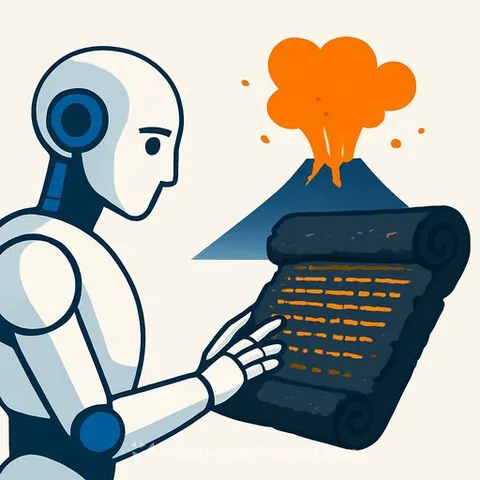
For the first time, researchers have identified the exact title of an ancient book without physically opening it. The Vesuvius Challenge team deciphered a carbonized scroll from Herculaneum and found the Greek text "On Vices, Book 1" by the Epicurean philosopher Philodemus - a document that had remained sealed since the eruption of Mount Vesuvius in 79 AD. The scroll, cataloged as PHerc. 1667, is the first to be read in its entirety from beginning to end.
Discovered in 1752 in a lavish villa likely owned by Julius Caesar's father-in-law, roughly 1,800 scrolls were turned into charcoal sticks by the heat of the eruption. Any attempt to unroll them by hand still reduces the material to dust. This forced a different approach: never touching the scrolls at all.
Virtual unrolling and AI ink detection
Computer scientist Brent Seales of the University of Kentucky spent over twenty years developing a non-invasive method. Each scroll is placed inside a particle accelerator that performs an extremely fine X-ray scan. The rolled-up layers are reconstructed in 3D, then virtually unrolled on screen - analogous to flattening a puff pastry without tearing it.
The hardest problem followed. The era's ink is made of carbon, identical to the burnt papyrus it sits on, making it nearly invisible on the scans. To recover the text, the team trained an AI to detect the subtle texture differences left by letters, gradually redrawing a script the human eye cannot see. This approach exemplifies AI for Science & Research, where machine learning extracts signal from noise in data that traditional methods cannot resolve.
New texts and a multi-volume revelation
The results yielded 70 new columns of text from PHerc. 1667. On another scroll, the team found the phrase "Philodemus, On the Gods, Book 8," revealing that the work spanned multiple volumes - something historians had not suspected. "For the first time, we know the exact title of an ancient book without having opened it," the researchers noted, referring to the "On Vices" inscription found midway through the still-rolled papyrus.
The carbonized library of Herculaneum is the only one from the entire Greco-Roman world to survive more or less intact. Unlike most classical texts, which reached us as fragments copied during the Middle Ages, these scrolls are direct physical artifacts from the 1st century BCE, offering an unmediated view of ancient thought.
Why this matters for Science and Research
The project illustrates how physics-based imaging paired with machine learning can extract data from objects long considered inaccessible. The same principle - non-destructive scanning followed by AI-driven signal recovery - has direct parallels in materials science, medical diagnostics, and archival research. For scientists looking to bring similar analysis methods into their own work, a structured AI Learning Path for Research Scientists provides a foundation for applying machine learning to complex, noisy datasets. The Vesuvius Challenge demonstrates that when imaging and artificial intelligence converge, even a scroll that burned nearly 2,000 years ago can still be read.