
AI news ·
AI reconstruction reveals final hours of two Pompeii victims killed in Vesuvius eruption
AI reconstructed the final moments of a Pompeii victim for the first time, showing a man shielding himself from volcanic debris during the 79 AD eruption. Researchers say the volume of data at the site now requires AI to process it properly.
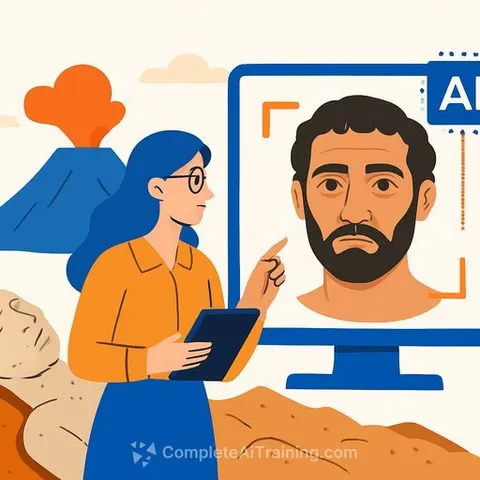
AI reconstructs final moments of Vesuvius victims in Pompeii
Researchers in Italy have used artificial intelligence to reconstruct how a man died during Mount Vesuvius's eruption in 79 AD, marking the first time the technology has been applied to individual victims at the archaeological site.
The University of Padua collaborated with Italy's Ministry of Culture on the project, which combined AI software with photo-editing techniques to create a scientifically grounded image based on skeletal remains and artifacts.
The man's body was found in the Porta Stabia necropolis. He died during heavy ashfall while attempting to shield himself from volcanic debris. A terracotta vessel discovered next to him had likely been used to protect his head from falling lapilli and rock fragments.
A second victim, a younger man, was killed by a pyroclastic flow-the superheated mixture of gas and ash that struck the city in later stages of the eruption.
Data at scale requires new methods
Excavations at Pompeii have uncovered ceramic lamps, iron rings, and bronze coins that provide context for how residents experienced the catastrophe. The volume of archaeological data now exceeds what traditional analysis methods can process.
"The sheer volume of archaeological data in Pompeii has reached a point where only the use of artificial intelligence will allow us to properly preserve and interpret it," said Gabriel Zuchtriegel, director of the archaeological park.
Italy's Minister of Culture Alessandro Giuli said the work demonstrates how AI for Science & Research can improve how knowledge is shared with broader audiences while maintaining scientific standards.
For researchers working in fields that generate large datasets, this application suggests how AI Research Courses might address similar challenges in data interpretation and reconstruction across disciplines.