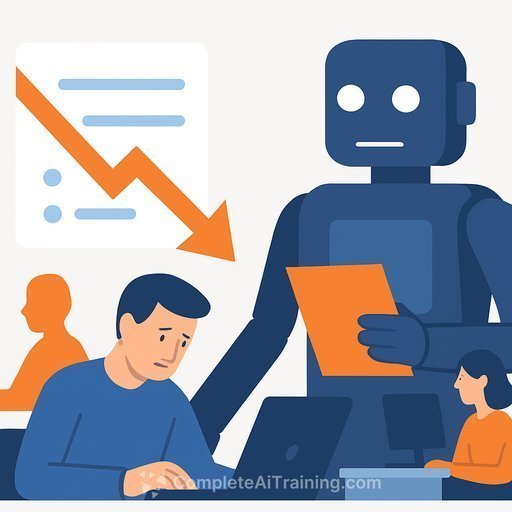
AI Is Rewriting China's Labor Market. Here's What HR Should Do Next
AI in China isn't just swapping jobs in and out. It's creating new professions, lowering the cost to start a business, and forcing a faster cycle of skill renewal across every sector.
For HR, that means three priorities: build human-machine teams, shorten learning loops, and update job architecture to match how work actually gets done now-faster, more modular, and more automated.
The Signal: New Roles, Higher Pay, Real Demand
- New roles are showing up everywhere: AI content annotator, AI product manager, AI-assisted animator.
- PwC's 2025 Global AI Jobs Barometer reports a 56% wage premium for AI skills-up 25% from last year. Source
- China's Q4 2025 AI job postings grew 19% year over year, led by algorithm engineers, machine vision specialists, and robotics algorithm developers.
As Liu Cong of iFLYTEK puts it, "AI is pushing the labor force toward higher value-added roles centered on human-machine synergy and intelligent augmentation." Build for that mix, not one or the other.
On the Ground: Doctors to AI Trainers, Merchants to Model Users
In Hefei, a former gastroenterologist, Hu Pingping, now trains a medical large language model-pairing clinical judgment with model behavior analysis. That's a blueprint for future job design: domain experts amplified by AI fluency.
In Wuhan's historic Hanzheng Street, over 50 apparel business owners filled an AI training session-designers born after 2000 sitting next to shop owners from the 1970s, some bringing their kids to learn. Instructor Yang Jian, a designer-turned-entrepreneur, focuses on getting small and mid-sized firms to use AI across design, manufacturing, and marketing.
The message for HR: treat AI literacy like safety training-it's for everyone, not just "tech."
One-Person Companies (OPCs) Are Rising-And They Compete With You
AI is lowering the barrier to entrepreneurship across China. Cities like Suzhou are positioning themselves as OPC-friendly hubs, supported by local policies and a growing talent pool.
Wei Qing, CTO at Microsoft China, notes that AI is becoming as common as electricity or the telephone-and AI agents let "one person function like a full team." Expect more solo specialists, fewer traditional teams, and an uptick in short-term, high-impact contracting.
Implication for HR: your competitors for talent aren't just other firms-the best individual operators in your market are potential rivals. Make your work model flexible enough to attract both full-time hires and high-caliber independents.
The Risk: Shorter Career Half-Lives
The pace of AI upgrades is shortening career lifecycles. The old idea of "one skill for a lifetime" is getting harder to defend, and transitions are tough for workers without a path.
Professor Zhang Junping from Fudan University expects more "slash careers"-people building multiple income streams over time. His advice: avoid relying on a single skill, build broader capabilities, and keep judgment, creativity, and emotional intelligence at the center.
Policy Backdrop You Can Leverage
China's "AI Plus" initiative backs AI skills training to spark innovation, entrepreneurship, and re-employment. The Ministry of Industry and Information Technology is forecasting AI talent demand, publishing reports, and supporting universities to align programs with market needs.
Minister of Human Resources and Social Security Wang Xiaoping says the country will move faster on monitoring, early warning, and response to AI's impact on employment-aiming for an employment-friendly path. Translate that into action by aligning your internal upskilling programs with public training and incentives.
HR Action Plan: 90-Day Moves
- Update job architecture: Add AI-enabled variants to key roles (e.g., "Data Analyst (GenAI)", "Designer (AI-assisted)"). Define what changes in outputs, tools, and skill levels.
- Launch a skills audit: Map current roles to AI skills: prompting, tool selection, workflow automation, model evaluation, data governance, and change leadership.
- Create AI learning lanes: Three tracks: essentials for all, tool stacks by function (sales, ops, finance, creative), and deep technical for builders and stewards.
- Build human-in-the-loop workflows: Document where people make final calls-quality, safety, compliance, brand-and train for those checkpoints.
- Pilot with business owners: Pick 2-3 teams (e.g., customer operations, procurement, product design). Run 8-12 week sprints with clear cost/time/quality targets.
- Open your talent model: Add OPCs and expert freelancers into project staffing. Standardize contracts, IP rules, and security onboarding.
- Comp refresh: Add AI-skill pay differentials and spot bonuses for automation wins that hit measurable KPIs.
- Guardrails: Publish policies for data use, bias review, and model transparency. Train managers to spot failure modes, not just use features.
Metrics That Matter
- Productivity: Cycle time per task, cost per output, quality/defect rates with and without AI.
- Adoption: Weekly active AI users, percentage of processes with AI steps, time-to-proficiency post-training.
- Talent: Internal fill rate for AI-heavy roles, skill coverage vs. demand by function, retention for AI-skilled employees.
- Risk: Policy violations, model errors caught at human checkpoints, audit pass rates.
Keep Learning Practical
Short, job-based learning beats theory. Anchor training in live tasks-drafting RFPs, building product descriptions, analyzing supplier quotes, triaging support tickets. Tie each course to a before/after KPI.
If you need a quick starting point for function-specific upskilling, explore curated options by job role and certification tracks: Courses by Job, Popular AI Certifications, or the AI Learning Path for Training & Development Managers for L&D-focused curricula.
What Stays Human
Even as models generate content faster than teams can review it, the edge remains human: imagination, taste, critical thinking, and emotional intelligence. Build roles and incentives that reward those traits, not just prompt speed.
Zhang suggests bringing "AI thinking" into youth education while avoiding over-reliance. The skill is using AI wisely, not outsourcing judgment.
Bottom Line for HR
AI is pushing work to higher-value, human-plus-machine roles. The winners will be the companies that make learning continuous, open their talent model to expert independents, and protect judgment where it counts.
Start small, measure fast, scale what works. Your workforce will thank you-with better output and stronger careers.
Your membership also unlocks: