
AI news ·
AI replaces managers as the organizational relay function becomes obsolete
A digital-payments firm cut nearly 40% of its staff and eliminated management titles. It replaced management with an AI layer that aggregates information.
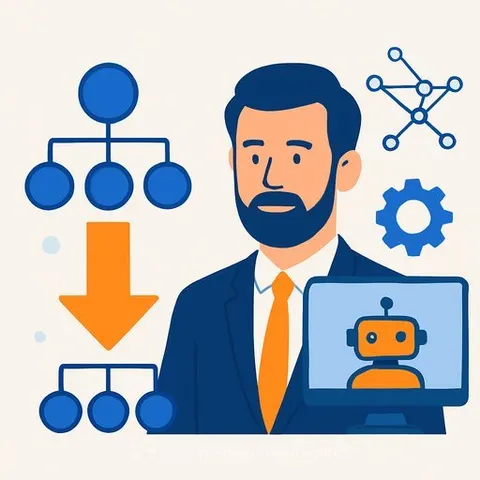
A large digital-payments company cut its workforce by nearly 40%, abolished all formal titles, and compressed management layers to two or three - with an ultimate goal of zero. The replacement was not a new org chart but an AI intelligence layer designed to aggregate information and enable decisions without the distortion of human relay stations.
In a public statement, the chief executive said, "The most important thing we can do is get rid of the noise between the people doing the work and the people making decisions about it. AI can be that connection. Humans were never good at it anyway." This kind of strategic reorientation sits at the center of AI for Executives & Strategy.
The constraint that created hierarchy
The pyramid did not emerge only from a desire for control. It solved a hard cognitive problem: humans can coordinate only a limited number of direct relationships before information becomes unmanageable. Organizational theorists call this the span of control. Beyond a certain point, coherence breaks down.
The solution was to add layers. Each layer compresses information flowing upward and distributes instructions downward. The pyramid is a lossily compressed communication network built from human neurons. That compression solved one problem but created another. With every relay, the signal degrades. By the time a report reaches the top, it often bears only a family resemblance to ground truth.
Digitalization dissolves the premise
The premise of hierarchy was that no other way existed to aggregate organizational information at scale. That premise dissolved quietly over the past two decades. Today, employees generate continuous digital traces: messages, code commits, document revisions, calendar records, collaboration patterns. Feeding this data stream into large language models produces a real-time organizational world model - more current than a quarterly report and less dependent on human intermediaries.
If the information-relay function that once justified middle management has been automated, the pipes are no longer needed.
The new architecture: circles, not pyramids
In this redesigned structure, the organizational center of gravity is an AI intelligence system that holds the continuously updated factual state of the company. Everyone works in relation to this system. Information no longer flows through ranks but is available simultaneously to those who need it.
People occupy one of three roles defined by their relationship to outputs rather than to other people:
- Builders: those who make things. Their core competency is judgment of what is worth building.
- Directly Responsible Individuals: those who own outcomes that customers experience. They assemble teams, disband them when the work is done, and carry personal accountability for the result.
- On-Field Coaches: senior leaders who work at the front lines. Their authority is earned from demonstrated mastery.
The traditional role of "manager" no longer exists, as coordination has been transferred to the AI layer. This shift is forcing a re-evaluation of what AI for Management actually means in practice.
Learn from earlier attempts
The dream of manager-less organizations is not new. Holacracy, formalized in 2007, replaced hierarchical titles with dynamic circles and roles. A well-known online retailer adopted it company-wide; about 18% of employees left, and the company later moderated its implementation. The difficulty was not ideological. It was infrastructural. Without a mechanism to automatically aggregate organizational information, removing the management layer simply relocated coordination costs into endless governance meetings.
Other cases point in the same direction. A European fintech company reported that its AI assistant handled a large share of customer-service interactions within its first month, and it restructured remaining teams to give product groups direct access to customer outcome data, compressing the management layer to near zero. A global music-streaming company's widely studied "squad" model highlighted the persistence of coordination overhead in scaled autonomous systems.
When hierarchy remains necessary - and when it becomes toxic
Hierarchy is not always obsolete. It remains appropriate when information cannot be automatically aggregated, when tasks are highly standardized, when operating environments are stable, and when the workforce does not support high degrees of self-management. In steel manufacturing, traditional banking, logistics, and public health bureaucracies, the pyramid remains efficient.
Hierarchy becomes counterproductive when AI can aggregate information in real time, eliminating the relay function; when value creation depends on creative judgment that hierarchical approval chains delay and dilute; when competitive environments change faster than structures can process; and when the scarce resource is human ingenuity rather than standardized execution. In these conditions, hierarchy actively destroys value by inserting distortion, delay, and political filtering between reality and decision.
The human contribution
What remains for people are three distinct capacities. Judgment in conditions of genuine ambiguity: determining which rules apply, which values to weight, and what the right question is. Accountability for outcomes that matter to other human beings: the willingness to stand behind a decision and bear its consequences, a form of moral agency AI cannot possess. Empathy as professional competency: sensing what is not being said, reading emotional reality, and responding to another person's humanity in ways that change what is possible between them.
Why this matters for management
For managers, the signal is clear. The value you provide can no longer be information aggregation or approval routing. It must be judgment in ambiguity, accountability for outcomes, and the empathy that AI cannot replicate. The organizations that survive this shift will be those where managers become coaches and decision-makers, not relay stations. The work now is not to defend the old structure but to build the institutional frameworks that direct AI toward human ends - and to develop the capacities that make that direction worth following.