
AI news ·
AI safety in healthcare extends beyond cybersecurity to include model drift, misuse, and opacity, expert says
Hospitals focused on AI cybersecurity are missing a bigger threat: AI that harms patients while working exactly as designed. Model drift, misuse, and opaque outputs can turn clinical AI tools into patient safety risks.
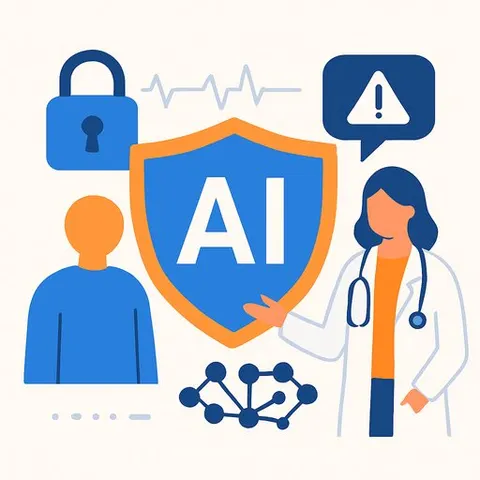
Health Systems Miss Critical AI Safety Gaps Beyond Cybersecurity
Hospitals and health systems integrating artificial intelligence into clinical care often focus on protecting AI systems from hackers and data breaches. They're overlooking a second, more consequential form of safety: preventing the AI itself from causing patient harm even when functioning as designed.
The distinction matters because a model can perform well in development and still fail in real clinical settings. Populations shift. Workflows change. Patient demographics differ from training data. A clinic may deploy an AI tool outside the setting where it was validated, or the model may work well overall but perform poorly in specific subgroups.
Three Safety Gaps in Clinical AI
Model drift. AI systems become less reliable as the world around them changes. This includes changes in patient populations, clinical workflows, and data patterns.
Misuse. Clinicians deploy AI in settings, patient populations, or clinical decisions the system was never built for.
Opacity. Nobody can explain why the model made a particular recommendation. Users cannot understand the reasoning behind the AI's output.
When AI Safety Becomes Patient Safety
Consider an AI sepsis alert that fires constantly. High sensitivity sounds protective until clinicians begin ignoring it-a response that turns a performance problem into a safety crisis. A patient may die because the alert lost credibility through overuse.
Or consider generative AI drafting personalized patient messages. The output sounds polished, empathetic, and confident. It may also be clinically wrong. The danger lies not in robotic language but in trustworthy-sounding language that misleads both patients and clinicians.
Safety as a Lifecycle Problem
AI safety in healthcare is not a launch issue. It is a lifecycle issue requiring constant monitoring from deployment through retirement.
The World Health Organization has made clear that AI for Healthcare raises ethical and safety questions extending far beyond cybersecurity. The focus shifts to accountability, transparency, and protection of public interest.
Four elements require protection: patients and clinicians, care decisions and operations, data and equity, and most importantly, trust itself. An unsafe AI system is one that quietly teaches the healthcare system to trust the wrong thing.