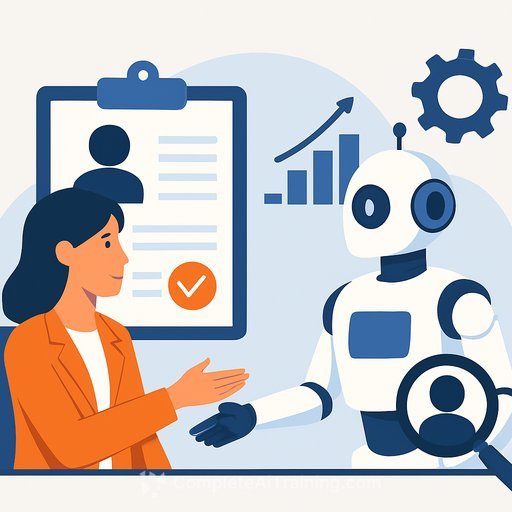
AI screening is rejecting job candidates in minutes, creating a hiring bottleneck for entry-level workers
Bhuvana Chilukuri has applied for more than 100 jobs and been rejected by all of them. Some rejections arrived within two minutes of submission. The 20-year-old Queen Mary University student is convinced her applications never reach a human recruiter.
She is not alone. Recruiters across the UK are increasingly using AI to filter applications before any human sees them. Some 89% of UK recruiters say they plan to use more AI in hiring this year, according to LinkedIn data.
For job seekers, the process is blunt. Candidates face AI-screened CVs followed by video interviews where they answer questions while recording themselves. "I do tend to feel like a robot," Chilukuri said. "You're just seeing yourself on screen for almost 20 minutes. You become sort of monotone. You don't speak to anyone, and it takes away your personality."
Why companies are turning to automation
The volume of applications has become unmanageable. Law firm Mishcon de Reya received 5,000 applications for 35 roles in its last hiring round. Adecco CEO Denis Machuel said candidates now need to send an average of 200 applications to secure a job offer.
"What AI brings is scale," Machuel said. "Before, you would reach out to 50 people, and out of that you will take one, so you will have 49 people frustrated. Now, if you reach out to 500 candidates, you create 499 people frustrated."
Job vacancies have almost halved since the post-pandemic peak. Higher costs for employers and stronger legal protections for new hires have made firms reluctant to recruit, intensifying competition for fewer positions.
The arms race: candidates fighting back with AI
Some job seekers are using AI to write their CVs and generate applications. Chilukuri understands the logic. "They're getting floods of applications. So I don't blame them. But it's coming to a point where students are becoming lazy," she said.
This creates a feedback loop. More AI-written applications make it harder for recruiters to distinguish genuine candidates from those using automation. Tom Wickstead, early careers manager at Mishcon de Reya, said: "We've got more legal graduates, we've got fewer graduate roles, and we've got more candidates using AI to write more applications. So for us as an employer, we've got this explosion of applications, and it's harder to tell the difference."
Can AI make hiring fairer?
Some firms argue AI recruitment tools could reduce human bias. Mishcon de Reya is trialling an AI chatbot that screens candidates in real time and flags applications potentially written by AI.
Wickstead said: "I just don't think that any recruitment process is free from bias. What AI has a potential to do is be far more consistent, far more fair than the old process." He stressed that human recruiters still conduct later interviews and make final hiring decisions.
Machuel said the solution requires combining both approaches. "What needs to happen is to inject the AI smartness at the right moment in the process, so that you compliment the efficiency of AI with the judgement and human touch of people," he said.
Chilukuri remains sceptical. "I don't trust the AI. I think I'll always trust a person. But it's hard to get the opportunity to see the person," she said.
HR professionals managing recruitment systems should understand both the efficiency gains and the risks of over-reliance on automation. Learn more about AI for Human Resources or explore the AI Learning Path for CHROs to develop strategies that balance automation with human judgment.
Your membership also unlocks: