
AI news ·
AI-skilled workers in Australia earn 62% wage premium as job postings double
Australian AI workers earn a 62% wage premium as related job postings doubled in one year. Employers pay more for staff combining technical skills with human judgment.
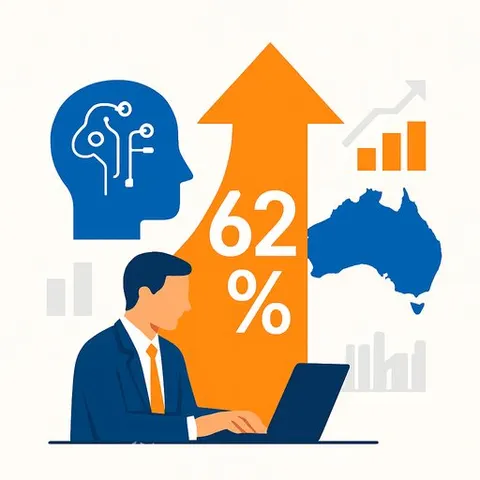
AI-skilled workers in Australia now earn a 62% wage premium as job postings requiring artificial intelligence capabilities more than doubled from 20,000 to 41,000 in a single year, according to PwC Australia's 2026 AI Jobs Barometer. The increase-up from a 57% premium the previous year-follows four years of stalled growth and signals a tightening talent market where employers pay more for workers who blend technical AI knowledge with human judgement.
The surge spanned all sectors, but wage premiums form a U-shaped pattern across industries. Technology, Media and Telecommunications leads at 59%, followed by Manufacturing at 57% and Financial Services at 43%. At the other end, Energy, Utilities and Resources offers just an 8% premium, while Government and Public Sector sits at 24%.
PwC Australia partner and workforce practice lead Emma Hardy said, "The advantage in today's tight labour market isn't having the technical expertise alone. Professionals who can apply trusted human skills are the ones who are becoming highly sought after in our rapidly changing workforce." She added that organisations see this combination as essential to building AI foundations and are using higher wages to attract those candidates.
These findings align with a separate five-year labour market analysis by the Australian Institute of Business, which found net job availability for AI-exposed roles grew 10% from 2019 to 2024. The AIB also tracked the AI skill premium doubling from 25% in 2023 to 56% in 2024, with AI-skilled workers earning a median salary of $143,000 compared with $104,000 for the broader workforce.
A two-track labour market
PwC's barometer identifies a split between professionalised and democratised roles. Professionalised roles-such as radiologists, employment recruiters, and air traffic controllers-require greater human expertise as AI handles routine tasks. Democratised roles-like medical secretaries, software developers, and loan officers-see AI enabling non-experts to perform work that previously needed specialist skills.
Half of all advertised jobs in Australia are currently democratised, while roughly a quarter are professionalised and the remaining quarter have low AI exposure. Since 2021, professionalised roles have seen twice the growth in job advertisements globally and 42% faster salary increases than democratised equivalents.
In the most AI-exposed roles, new tasks are 2.5 times more likely to require human-intensive skills such as empathy, creativity, and leadership. Workers in those occupations have developed an average of 187 new skills since 2019, compared with 93 for the least-exposed occupations. Many of those new skills tie to domain expertise, professional judgement, and regulated practice.
Peter Wheeler, PwC Australia's Managing Director of workforce and change advisory, said, "The workforce of tomorrow will be less 'doing' and more 'thinking.' As AI adoption increases, critical thought, judgement, and curiosity will be highly regarded." He sees this as a chance to reimagine traditional learning pathways and embed responsible AI principles into work.
Why this matters for HR professionals
The 62% wage premium and doubling of AI-related job ads mean HR teams must revisit compensation bands and talent acquisition strategies with fresh urgency. Professionalised roles are growing faster and commanding higher pay, so workforce planners need to distinguish which roles in their organisation will deepen human expertise versus those AI will democratise. Upskilling programs should go beyond technical AI literacy to build the judgement, creativity, and leadership skills that the research shows are rewarded. For HR leaders preparing to develop these intersecting capabilities, resources such as AI for Human Resources offer practical starting points for integrating AI into people practices.