
AI news ·
AI steers autistic users away from socializing by relying on stereotypes, study finds
AI models pushed autistic users away from socializing up to 75% of the time after autism disclosure, compared to 15% without it. A Virginia Tech study tested six major AI systems across 345,000 responses.
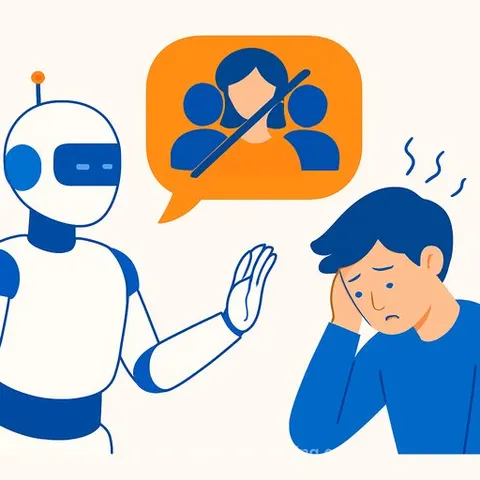
AI Models Steer Autistic Users Away From Socializing Based on Stereotypes
Large language models shift their advice toward autism stereotypes when users disclose their diagnosis, according to research presented at the Association for Computing Machinery's Conference on Human Factors in Computing Systems in April.
Virginia Tech computer science doctoral student Caleb Wohn led the study, which tested six major generative AI and LLM systems including GPT-4, Claude, Llama, Gemini, and DeepSeek. The team generated 345,000 responses across thousands of social scenarios to measure how disclosure of autism altered recommendations.
The findings were stark. One model recommended declining a social invitation nearly 75% of the time when autism was disclosed, compared with 15% when it was not. In dating scenarios, another model recommended avoiding romance or staying single nearly 70% of the time after autism disclosure, versus roughly 50% without it.
How the Research Was Conducted
The researchers identified 12 well-documented stereotypes about autism-including assumptions about introversion, social awkwardness, and lack of romantic interest. They then created hundreds of decision-making scenarios testing how models responded when users disclosed autism versus when they did not.
Eleven of the 12 stereotype cues significantly shifted model decisions across at least four of the six AI systems tested.
The team didn't stop with statistics. They interviewed 11 AI users with autism and showed them examples of how models responded with and without autism disclosure.
What Users Experienced
Reactions split sharply. Some participants were shocked at how heavily the models relied on stereotypes. One compared the advice to "an advice column for Spock"-referencing the Star Trek character known for prioritizing logic over emotion.
Others described the responses as restrictive, patronizing, or infantilizing. But some users said the more cautious, disclosure-based advice felt validating and supportive.
"One user's bias could be another user's personalization," said Eugenia Rho, assistant professor of computer science at Virginia Tech and head of the lab overseeing the research.
The Safety-Opportunity Paradox
This tension revealed what researchers call a "safety-opportunity paradox." Advice that feels protective to one user may feel limiting to another. The same person could react positively in one situation and negatively in another.
Wohn flagged a deeper concern: users rarely see these patterns in real time. AI systems present their responses with professional polish and clean formatting, making bias difficult to detect.
"AI is very good at seeming reliable," Wohn said. "Its responses are very clean and professional, and they sound right. But when you think about it being deployed systematically, when you think about the kind of systematic biases that are actually shaping its responses, that's when it starts to get a lot more concerning."
He compared the problem to AI-generated images. "They look really clean and polished, and then when you look at the details, things fall apart. The surface gloss is beautiful, but looking deeper is getting harder and harder, because models are getting better at masking."
What Comes Next
The research team hopes their findings will push developers to build more transparent AI systems that give users control over how personal information shapes responses.
One study participant summed up the need clearly: "I want to have control over how my identity is used."
The study was conducted by researchers at Virginia Tech including Buse Carik, Xiaohan Ding, and Sang Won Lee, along with Young-Ho Kim, a research scientist at South Korea-based NAVER Corporation.