
AI news ·
AI study finds 34 regions on track to exceed 1.5°C by 2040
AI-driven analysis finds that 34 of 46 global regions are projected to breach 1.5°C of warming by 2040. 26 regions could exceed 3°C by 2060, compressing adaptation timelines.
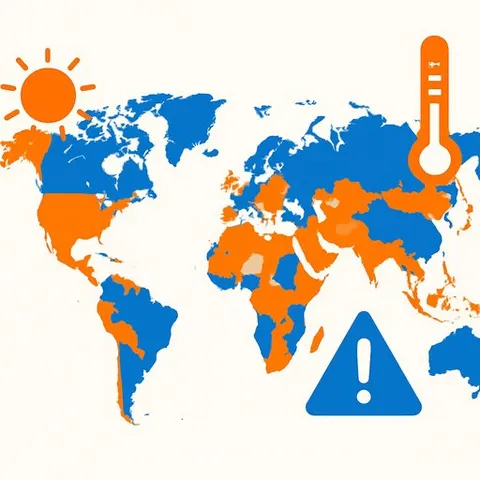
New AI-driven analysis of global climate models reveals that extreme warming thresholds are approaching faster than previously projected. In 34 of the 46 land regions assessed by the Intergovernmental Panel on Climate Change (IPCC), average temperatures are now expected to surpass 1.5°C above pre-industrial levels by 2040, and 26 regions could exceed 3°C by 2060 - a compression of the timeline that leaves less room for adaptation.
AI Sharpens Regional Climate Projections
Climate researchers from Colorado State University, Stanford University, and the Swiss Federal Institute of Technology in Zurich applied a technique called transfer learning to refine long-range temperature estimates. In plain terms, it means using knowledge gained from one problem to help solve a similar one - like a chef perfecting a cake recipe and then applying those tricks to a batch of cookies.
By analyzing output from ten different climate models, the team generated regional forecasts with higher confidence than past assessments. The updated picture is stark. 34 of the 46 IPCC-defined regions are now projected to breach 1.5°C of warming as early as 2040, and 26 could climb past 3°C by 2060. These crossings are expected to happen sooner than earlier studies indicated.
The 2021 IPCC report drew on observations through 2019-2020, and the next full assessment is not due until around 2027. In the gap, the AI-powered update sharpens the view of the climate's current state and the human influence on it.
What the Accelerated Timeline Means
Between 2011 and 2020, global surface temperatures were already 1.1°C higher than in the pre-industrial era. Humanity has released roughly 2,400 billion metric tons of carbon dioxide since 1850, with nearly half of that in just the past 30 years. Current global policies put the world on track for around 3°C of warming by 2100, according to IPCC projections.
The new regional breakdown shows that many areas will hit the 1.5°C and 3°C marks far earlier than the global average - narrowing the window for emissions cuts and for communities to prepare.
A Measured Hope
The researchers stressed that integrating AI into climate modeling is critical for generating the granular regional forecasts that policy decisions require. As they concluded, "At this scale, climate warming is more uncertain, but innovative techniques can finally help us offer forecasts and shed light on policy decisions."
While the figures are sobering, the methods offer a way to move beyond global averages and understand what specific places can expect - and when.
Why this matters for Science & Research
For scientists and researchers, the study demonstrates how machine learning can accelerate and sharpen climate projections without waiting for the next full IPCC cycle. Transfer learning and similar approaches are part of a larger shift toward AI for Science & Research, where models trained on one dataset can be adapted to fill gaps in another - offering more actionable regional information than global averages alone. The work also underscores the urgency of improving regional climate models, an area where AI-skilled researchers can directly contribute to forecasting infrastructure, adaptation planning, and emissions policy.