AI's Broken Promise in Customer Service: Why GenAI Costs Are Set to Rise-and What to Do About It
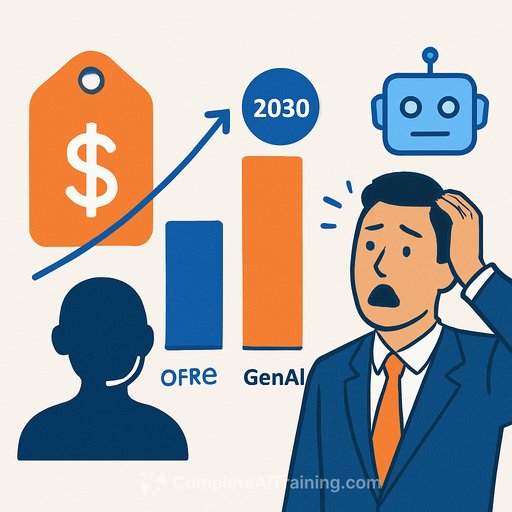
Cheap, fully automated support was the dream. Gartner now says the math won't hold. By 2030, the cost per GenAI resolution in customer service will exceed $3-higher than many offshore human agents.
This flips the common pitch that AI will slash costs across the contact center. The reality: subsidies are ending, usage is exploding, and infrastructure isn't keeping up.
The Big Prediction
Gartner's take is blunt. GenAI costs will outpace offshore agents on a per-resolution basis by decade's end. The problem isn't the per-token price you see on a vendor's website.
As Patrick Quinlan, Senior Director Analyst at Gartner, put it: "It's not just like the per unit cost from a consumption perspective... many organizations consume a lot more than they expect, and then they don't account for the total cost of ownership."
Why Costs Are Rising
- Subsidies are fading: LLM vendors have been discounting by up to 90% to grow fast. Quinlan expects that to change as firms chase profit.
- Usage creep: Early pilots look cheap. Production volume isn't. Token usage balloons with real customers, real variance, and longer dialogues.
- Talent premiums: You'll need higher-paid AI, data, and platform talent-not just agents-to deploy and maintain reliable systems.
- Frontier model sprawl: Newer models consume 3-10x more tokens for similar tasks. Even with lower unit prices, the bill can rise.
Infrastructure Reality Check
GenAI doesn't scale like traditional software. More users means more compute, almost linearly. That drives massive data center build-outs, energy demand, and hardware churn.
- Electricity constraints: Data center hotspots have seen electricity bills spike. Some U.S. states have moved to limit utilities from passing infrastructure costs to consumers, pushing the burden back on vendors.
- Off-grid experiments: Some companies are exploring small modular reactors to power data centers because the grid can't keep up. What are SMRs?
- Water and chips: Cooling water is scarce and pricey. Specialized AI chips often burn out in 1-3 years and need replacing.
Quinlan's summary: "Trillions of dollars" are being invested. Shareholders will want a return. Prices will move.
For broader context on data center energy pressures, see the IEA's analysis of data centers and networks: IEA overview.
The Rehire Wave
Gartner also predicts that by 2027, half of the companies that cut service staff because of AI will rehire for similar functions (possibly with new titles). The "AI cuts jobs" narrative doesn't match what leaders report on the ground.
In an October 2025 Gartner survey, only 20% of customer service leaders had reduced agent staffing due to AI. Emily Potosky, Senior Director of Research at Gartner, summed it up: "AI simply isn't mature enough to fully replace the expertise, empathy, and judgment that human agents provide." Kathy Ross, Senior Director Analyst at Gartner, noted that most recent reductions were driven more by macroeconomics than automation.
Where GenAI Actually Helps
Use GenAI to accelerate, not to decide. It's non-deterministic. That's the core issue. Resolution is where risk and cost pile up, and where deterministic tech (or humans) still win.
- Triage: Converse, understand, collect details, route correctly.
- Summarization and notes: Cut after-call work; standardize records.
- Intent and classification: Speed up routing and suggest next steps.
As Quinlan put it: "The valuable part of the process is the resolution... There are better technologies to provide resolution; you just have to pick and choose where you apply the technology." Expect efficiency and better experience-not sweeping cost cuts.
What Contact Centers Should Do Now
- Get real on TCO: Model end-to-end costs (tokens, infra, orchestration, people, model upgrades). Stress-test for volume spikes and long conversations. For guidance on designing data-driven pilots and evaluating cost/ROI, see AI Research Courses.
- Pick narrow, high-ROI use cases: Triage, summarization, and classification first. Avoid open-ended resolution without guardrails.
- Keep resolution deterministic: Use rules, workflows, knowledge retrieval, and well-tested automation. Insert GenAI for context and speed, not final decisions.
- Instrument everything: Track containment, deflection, error rates, handle time, escalations, token consumption, and recontact. Kill what doesn't earn its keep.
- Control model sprawl: Standardize on a small set of models. Gate frontier models behind strict business cases.
- Negotiate hard: Push vendors on pricing tiers, caching, context window tuning, and throughput caps. Plan for post-subsidy pricing.
- Invest in data readiness: Clean knowledge, clear intents, consistent taxonomies, and prompt libraries. Garbage in, expensive garbage out.
- Upskill your team: Train agents and leaders on AI-assisted workflows, prompt discipline, and escalation judgment. Consider role redesign instead of headcount cuts.
Expectations to Set With Your CFO
- Short term: experience lift and speed gains, modest savings.
- Medium term: higher infra and usage bills as volumes grow.
- Long term: vendor price resets when subsidies fade; higher unit costs for frontier models.
The pitch changes from "cost-out" to "experience and productivity." That's still valuable-just different.
Bottom Line
GenAI is a tool, not a silver bullet. The contact centers that win will pair GenAI for intake and acceleration with deterministic resolution, clean data, and trained people.
If you're betting on full automation to cut costs, expect disappointment. If you're betting on faster triage, better notes, and smarter routing, you're on the right track.
Helpful Next Steps
- Run a 90-day pilot for triage and summarization with strict usage caps and daily dashboards.
- Build a "decision matrix" separating deterministic resolution from GenAI-assisted steps.
- Stand up a small, cross-functional AI ops pod (CX, QA, data, security) to monitor drift, cost, and quality.
- Plan training for support roles moving into AI-assisted workflows. If you need structured options, see AI Productivity Courses.
The takeaway: Aim for smarter engagement, not full replacement. Keep humans in the loop where it matters most-the resolution.
Your membership also unlocks: