
AI news ·
AI supports but does not replace human judgment in senior recruitment, search leader says
AI in executive hiring risks filtering out candidates before human review, and can embed gender or ethnicity bias. Campbell Tickell also warns of AI-generated misrepresentations in candidate reports.
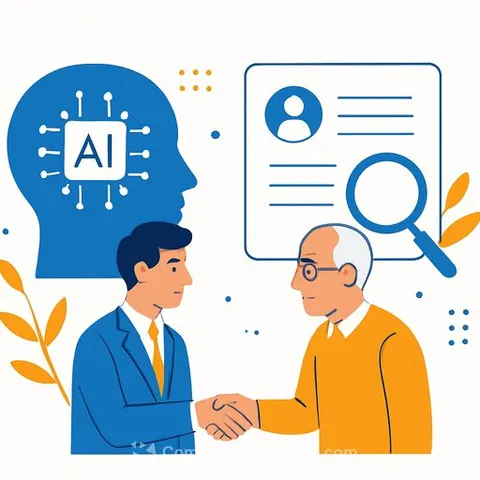
AI is already used by recruiters and employers to identify, evaluate and appoint new colleagues. But delegating executive-level hiring to AI can create serious problems, warns Jim Green, head of executive search and selection at Campbell Tickell. For HR professionals, the stakes include candidate invisibility, discrimination risks and the danger of AI-generated misrepresentations slipping into hiring documents.
The risk of invisibility in executive hiring
The most immediate fear for senior candidates is being filtered out before a human ever sees their application. Career paths at the top are often non-linear - spanning sectors, career breaks or portfolio roles - and algorithms tend to interpret these patterns as red flags. "Candidates may rightly worry that their profile will never reach a human decision-maker if algorithms filter them out at an early stage," Green said. Some organisations are even conducting AI-led interviews as a first screening step, removing direct human engagement entirely.
Bias and misrepresentation built into the process
Because AI draws on historical hiring data to replicate past decisions, it can embed the same biases it was meant to bypass. Green notes that research consistently shows AI systems can discriminate by gender, ethnicity and other protected characteristics. "Where candidates have moved across sectors, taken career breaks, or built portfolios of experience, AI may flag this as a material risk," he said. The problem extends beyond filtering. Campbell Tickell has heard reports of recruiters presenting client reports containing AI hallucinations within candidate write-ups. On the other side, job applicants use AI to polish CVs or generate overly effusive supporting statements - an approach Green says is not always to the candidate's benefit.
Where AI adds genuine value - and its hard limits
AI's strongest contribution comes during the research and mapping phase of executive search. It can analyse vast datasets to surface potential candidates who are not actively job-seeking but whose experience matches a role's requirements. "It tends to be most effective in supporting the research and mapping phases of a search, as a supplement to the recruiter's own headhunting," Green said. Expanding reach in this way can, in theory, broaden the diversity of candidate pools.
However, evaluating leadership potential remains a fundamentally human task. "Current AI tools are simply not designed to replace the nuanced evaluation required," Green said. "Even the most advanced systems struggle to interpret context, interpersonal dynamics, or the subtle indicators of leadership potential that experienced search professionals identify." At Campbell Tickell, no evaluation or ranking of candidates is ever conducted using AI. For HR teams that incorporate AI screening tools, AI Candidate Screening Training can help coordinators identify when algorithms are filtering unfairly and learn how to audit the outputs.
Why this matters for human resources professionals
Executive hiring decisions carry high stakes, and AI cannot yet assess judgement, cultural fit or the ability to handle ambiguity. HR leaders must treat AI as a limited support tool - useful for expanding talent searches, but never for making final evaluations. Understanding where the technology introduces bias or invisibility is a core competency for those managing recruitment today. For structured guidance on where automation helps and where it hurts, many professionals turn to AI Recruitment Automation Training to build safe, human-centred hiring practices.