Rising Global Demand for AI Talent Across Industries
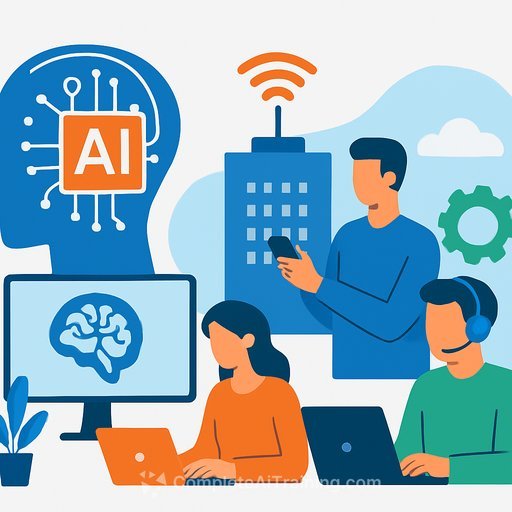
The demand for AI-related talent is surging worldwide, extending beyond tech companies into traditional sectors like manufacturing, energy, and logistics. Executive search experts observe a significant increase in senior AI appointments as organizations strive to integrate AI into their core operations.
For example, in Singapore, companies like in-flight caterer Sats have created new leadership roles such as Chief Digital Officer to spearhead digital strategy and embed AI, automation, and data analytics into their global operations. This trend reflects a broader shift where AI roles are becoming essential in various industries.
Key Sectors Driving AI Hiring
According to talent analytics specialists, financial services, professional services, logistics, and healthcare are seeing the most pronounced growth in AI-related roles. Many Asia-Pacific organizations are now establishing positions requiring AI skills, moving away from the traditional focus on data science and engineering alone.
Major global firms are also expanding their AI leadership. Semiconductor leader Intel and cosmetics giant Estee Lauder have recently appointed executives to lead AI and digital transformation efforts. Even governments are following suit, with federal agencies appointing chief AI officers to oversee AI initiatives.
Examples of Senior AI Appointments
- Standard Chartered named Yusuf Demiral as global head of wealth and retail banking data, analytics, and AI, focusing on scaling AI capabilities in these sectors.
- David Hardoon was appointed global head of AI enablement at the same bank, which has also adopted generative AI tools to enhance operations and customize marketing strategies.
These roles often carry a regional or global scope, highlighting the strategic importance of AI leadership in driving business transformation.
Building AI Expertise and Centres of Excellence
Many traditional companies are establishing AI Centres of Excellence to concentrate expertise and foster innovation. For instance, Deloitte has launched its Asia-Pacific Agentic AI Centre of Excellence, assembling over 120 AI specialists and 6,000 practitioners to develop AI agents capable of independent workflow coordination and adaptive learning.
Similarly, EY introduced EY Studio+, combining AI capabilities with design, marketing, and customer-experience technology across industries such as tourism, hospitality, and healthcare.
Agentic AI is expected to be a major trend, augmenting human roles and necessitating new job architectures and performance metrics.
Strategic Hiring: Avoiding the Pitfalls of Over-Hiring
Despite the enthusiasm, human resource professionals warn against over-hiring AI talent prematurely. Many companies have overestimated their immediate needs, leading to bloated teams and inefficient resource allocation.
Practical advice for HR and operations leaders includes:
- Focus hiring efforts on a few critical AI use cases at the country or regional level initially.
- Expand headcount cautiously, based on measurable business impact and market benchmarks.
- Balance centralization with experimentation to avoid fragmented or excessive AI initiatives.
Soft Skills Are as Important as Technical Expertise
AI experience alone is not enough. Candidates must demonstrate strong soft skills such as continuous learning, adaptability, and critical thinking. Evaluating AI-generated outputs accurately and anticipating ethical considerations are vital capabilities.
Learning agility and the ability to apply AI knowledge to business challenges will be key differentiators for professionals in this field.
For HR leaders looking to upskill teams or recruit effectively, exploring targeted AI courses can provide valuable support. Resources like Complete AI Training’s latest courses offer practical learning paths tailored to various roles and industries.
Your membership also unlocks: