AI Tools Could Speed Up Soil Research as Climate Pressures Mount
Researchers at the University of Sydney have outlined how artificial intelligence could help soil scientists tackle increasingly complex predictions about carbon storage, water systems, and food security as climate change intensifies.
Soil systems are notoriously difficult to model. They respond to climate, weather patterns, and agricultural practices in ways that shift constantly. Current machine learning approaches-digital soil mapping and spectroscopy-handle isolated tasks well but don't capture the full picture.
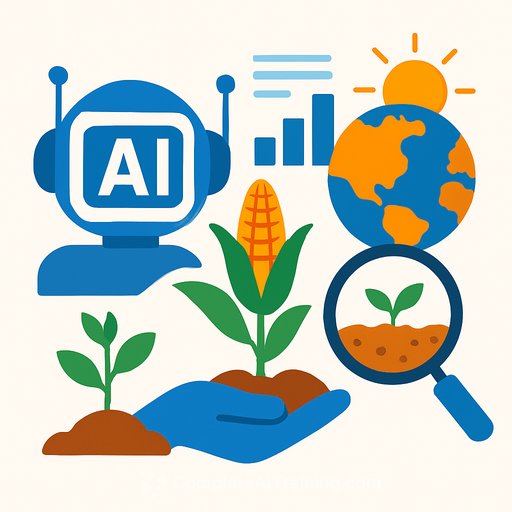
The new research, published in Frontiers in Science, proposes using AI systems that work more like scientific collaborators. These tools could create digital soil twins from sensor data, monitor soil microbiomes in detail, and test climate adaptation strategies in computer models before field trials.
What the research showed
The team tested a multi-agent AI system on a specific problem: what controls how much carbon soils can store. The system reviewed scientific literature and generated five hypotheses-covering climate influence, saturation thresholds, biological and chemical controls, feedback loops, and management strategies.
Experts then evaluated the outputs through simulated peer review. The AI system produced ideas that aligned with current research directions but went beyond what's typically being explored.
The practical gains are concrete. AI could automate time-consuming preparatory work-literature reviews, scenario development-freeing researchers to focus on field work and deeper questions that require judgment and creativity.
Where AI falls short
The researchers were direct about limitations. AI cannot replace the contextual judgment, creativity, and critical interpretation that scientists bring to their work. Data quality, model transparency, and dataset bias remain serious obstacles.
Computational costs and ethical considerations also demand attention. The system works best with strong human oversight and domain expertise built in from the start.
One co-author said: "AI agents also pose challenges around data quality, interpretability, creativity, and dataset bias, particularly without human oversight and domain expertise. We should treat AI as an augmentative tool that enhances, not replaces, human scientific work."
The practical path forward
The researchers stress that effective AI in soil science requires interdisciplinary collaboration and equitable access to tools. Human knowledge must keep pace with digital innovation.
Better soil understanding could support more sustainable agriculture, earlier detection of nutrient loss and erosion, and stronger climate adaptation strategies for land managers.
For researchers interested in how AI applies to scientific work, AI for Science & Research courses cover data modeling, laboratory optimization, and research automation-skills directly relevant to this emerging intersection.
Your membership also unlocks: