
AI news ·
AI tools gain ground in Illinois hospitals as doctors emphasize careful oversight
Illinois hospitals deployed 80+ AI tools for stroke detection, sepsis flagging, and documentation. They aim to reclaim hours from paperwork that now doubles patient-care time.
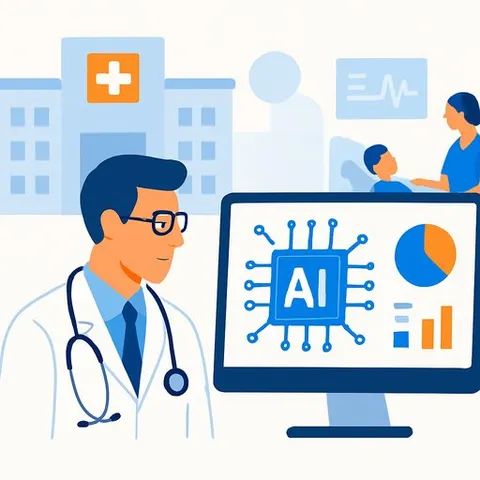
Illinois hospitals have deployed more than 80 AI-driven tools across emergency departments, electrophysiology labs, and outpatient clinics to detect strokes, flag sepsis risk, and document patient visits-a push that health system leaders say can claw back hours of administrative work and give clinicians more time with patients.
Decades of groundwork now moving into patient care
The roots of AI in medicine reach back to the 1956 Dartmouth Summer Conference, where researchers first outlined practical applications, according to the National Library of Medicine. Early systems like the ELIZA chatterbot (1964) and the INTERNIST-1 diagnostic consultant (1971) set the stage for the computer vision and natural-language tools now entering Illinois hospitals.
Today, Silver Cross Hospital in New Lenox uses AI software that rapidly identifies clots in stroke patients. OSF HealthCare deploys a platform for diabetic retinopathy screening, another for sepsis risk detection, and a third that flags patients who could benefit from end-of-life care discussions. Endeavor Health currently maintains an inventory of 80-plus active AI tools with another 30 to 40 in its pipeline, according to Dr. Nirav Shah, the system's associate chief medical informatics officer for AI and innovation.
Shifting time from paperwork to the bedside
"Healthcare is extremely regulated," Shah said, and providers often spend twice as much time on processes as they do on direct patient care. Add the national clinician shortage, and "that situation is going to get worse," reducing both access and safety. Shah estimates that AI can shrink time spent on marketing, supply chain, emails, research, and clinical documentation, shifting the typical two-thirds/task, one-third/patient ratio.
"If we're able to make our team members more productive, we'll be better able to take care of patients and the population at large in our communities," Shah said. The trend aligns with a broader focus on AI for Healthcare, where reducing administrative burden is one of the first measurable wins.
Diagnostics, cardiology, and a "second set of eyes"
In 2026, Silver Cross Hospital began using CartoSound Sonata, an AI-powered tool that converts ultrasound images into detailed 3D cardiac maps in 30 to 60 seconds. The technology cuts procedure time, increases precision, and lowers radiation exposure. Dr. R. Kannan Mutharasan, cardiologist and medical director of the Bluhm Cardiovascular Institute at Northwestern Medicine Palos Hospital, said AI-powered stethoscopes can classify heart murmurs and AI-enhanced ECGs and echocardiograms improve diagnostics. "As an experienced physician with well over two decades in cardiology care, I have not seen everything out there," Mutharasan said. "AI has seen everything."
St. Mary's Hospital in Kankakee and Saint Joseph Medical Center in Joliet use an AI device in the ED and ICU for rapid seizure detection, including non-convulsive seizures. "Over 90% of seizures are subclinical, with no outward signs," said Kristen Boswell, neuro-diagnostics supervisor at St. Mary's. The device allows staff to quickly decide whether to treat the patient in-house or transfer to a neurointensive care unit. St. Mary's was the first Illinois hospital to apply the device to children, Boswell added.
Dr. Rameez Alasadi, an interventional gastroenterologist with Silver Cross Medical Group, described AI-enhanced colonoscopies as "a second set of eyes" that helps detect polyps and raises the detection rate. "The higher the detection rate, the lower the risk of cancer," he said. Future iterations might highlight suspicious areas anywhere in the GI tract for precise biopsying, but "we're not there yet," Alasadi said.
Guardrails and the human connection
Karen Harris, senior vice president and general counsel for the Illinois Health and Hospital Association, said most doctors are deploying AI "very carefully and very thoughtfully." She added, "We still have to remember this is a tool and the humans still need to do a review, at least at this stage." Overreliance or complacency "is where mistakes happen," said Dr. Kanan Modhwadia, a psychiatrist and medical director at Northwestern Medicine Central DuPage Hospital. "We should be thinking about what we're doing and be very proactive. Because we're ultimately dealing with people. It sounds very simple, but humans care for other people. AI responds. But it doesn't reciprocate."
Mutharasan sees a different possibility. "Our vision for artificial intelligence is something that allows technology to completely fade away and elevate the human connection that is inherent in the care of the patient," he said. "I think that is an exciting possibility."
Why this matters for healthcare, IT, and development professionals
For clinicians, the rapid rollout of AI in Illinois hospitals shows that tools are already handling documentation, image analysis, and risk scoring-but every output still requires human review. IT and development teams face a growing demand to integrate AI into highly regulated environments while keeping validation workflows tight. The common thread across all roles is that AI is not replacing the provider; it is recasting the job, and organizations that invest in careful oversight and training will be the ones that preserve both safety and the clinician-patient relationship.