
AI news ·
AI tools help doctors cut documentation time but raise concerns over job displacement
AI scribe tools are cutting doctor documentation time and cost a fraction of human scribes, but accuracy errors still require physician review. Hospitals face pressure to adopt the cheaper option as some medical support jobs may disappear.
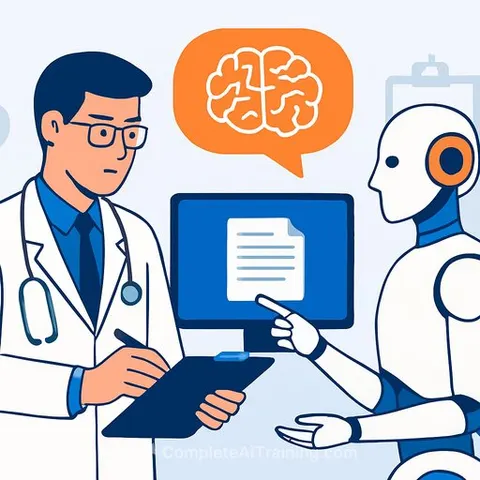
AI Scribes Cut Doctor Documentation Time, but Accuracy Gaps Remain
Doctors now spend less time on paperwork thanks to AI scribe software, but the technology still makes mistakes that require human review. Immunologist Julia Cronin at Sutter Health Palo Alto Medical Foundation uses Abridge, an app that records patient visits and generates clinical notes, alongside a human scribe.
Cronin said the tool has cut her documentation burden significantly. "At the end of the visit, sometimes I don't need to do much for my assessment and plan. It's already done for me," she said. One of her colleagues relies on the tool so heavily that she feels unable to work without it.
AI scribe systems cost around $100 per month per user, compared to roughly $2,800 monthly for human scribes. Hospitals face financial pressure to adopt the cheaper option, though some doctors prefer AI for another reason: patients feel more comfortable discussing private health information when no human is listening.
The Accuracy Problem
Abridge struggles with voice differentiation and context. When Cronin explains test results or performs an exam, the AI sometimes misinterprets what happened, forcing her to rewrite entire transcripts.
The same limitation appears in radiology. Radiologist Justin Shafa uses AI tools like Rad AI and Gleamer AI to detect fractures and identify conditions like brain bleeds and pulmonary embolisms. The software occasionally misses fractures or flags normal tissue as abnormal.
"They should make us faster and more accurate. They're not 100%, in any capacity. They're not perfect," Shafa said.
AI's accuracy depends on the data it learns from. When certain patient groups are underrepresented in training datasets, the AI performs worse for those groups. A 2019 DeepMind model for predicting kidney injury performed worse for women due to their underrepresentation in the training data.
Workforce Concerns
As hospitals adopt AI administrative tools, some medical support roles face elimination. Without strong workforce protections, workers whose tasks are largely automated could lose jobs.
Cronin suspects Sutter Health may discontinue scribe services as Abridge becomes more reliable. She said scribes frequently call out sick or work remotely from other countries, creating scheduling gaps that AI can fill.
What Doctors Want Next
Cronin sees potential for specialty-specific AI that learns medical templates and automatically fills in patient information before visits. She also wants AI to handle pre-charting - reviewing incoming patients and populating records with relevant history the day before appointments.
Radiology has led AI adoption in medicine, accounting for 18% of all AI-related medical publications from 2003 to 2023. Other specialties are following, though more slowly.
Carlos Buitrago Pizon, a technologist in interventional radiology, said human observation remains essential. "There is a lot of wrong detection that AI labels incorrectly. This is why human observation is still needed to properly diagnose a patient."
Learn more about AI for Healthcare and how AI Data Analysis supports clinical decision-making.