
AI news ·
AI tools help scientists cut waste and speed up research from lab bench to clinical trial
AI tools are helping labs cut waste by guiding smarter experiment design before resources are spent. From sustainable chemistry software to clinical trial prediction models, researchers are doing more with less.
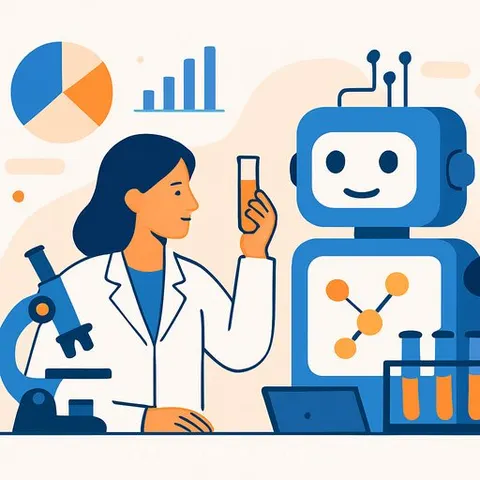
AI Tools Help Labs Cut Waste and Accelerate Research
Scientific research consumes enormous resources-electricity, water, chemicals, specialized equipment-with failed experiments generating waste at every step. AI is now helping researchers design better experiments upfront, optimize lab operations, and reduce the environmental cost of discovery.
Electronic lab notebooks get sustainability built in
A typical chemistry project involves hundreds or thousands of experiments, each requiring detailed records. Electronic lab notebooks (ELNs) replaced paper decades ago, but they remained passive storage systems.
In 2023, computational chemist Jonathan Hirst and his team at the University of Nottingham launched AI4Green, an ELN that actively guides researchers toward sustainable choices. When a chemist sketches a planned reaction and enters reagent details, the software automatically populates hazard data from external databases and calculates the green metrics of the proposed approach.
The tool flags solvents as a particular concern. Solvents account for roughly 90% of waste in pharmaceutical manufacturing, most of which gets incinerated. AI4Green includes a solvent selector that finds chemically similar alternatives with lower environmental impact. After experiments run, researchers can use an interactive data analysis tool to identify greener solvents for future iterations.
The software also integrates AstraZeneca's open-source route-scouting software to help chemists evaluate different synthesis pathways. Hirst's team is now developing a machine learning model for lifecycle analysis that will show researchers the full environmental impact of their choices, from reagent sourcing through purification.
The interface requires no special skills-anyone with a web browser can register and use it. "The biggest barrier is really mindset and chemists' willingness to do something different from what they've done before," Hirst said.
Sequential learning accelerates materials discovery
Cement production accounts for about 8% of global annual CO2 emissions. Researchers worldwide are testing alternative formulations using fly ash, biochar, and other substitutes, but the number of possible combinations is vast and testing each one takes months.
Sequential learning-a machine learning approach that suggests the most promising experiments to try next-can dramatically shrink this search space. In 2021, materials informatician Christoph Völker used sequential learning to evaluate alkali-activated binders as a cement alternative and identified suitable candidates in just 11 experiments.
Building and coding these models requires specialized technical skills, which limited adoption. To address that barrier, Völker's team developed SLAMD (Sequential Learning App for Materials Discovery), an open-source application that walks researchers through the process.
Users input desired properties and existing experimental results. The program analyzes this data and suggests the most promising experiments to run next based on factors the researcher weights. After each round of testing, the new results feed back into the system for another iteration of refined suggestions.
This cycle focuses investigation on the most impactful variables and reduces the total number of experiments needed. Fewer experiments means lower resource consumption, less electricity, and less money spent on the research process itself.
AI predicts clinical trial outcomes before they happen
Clinical trials represent the final, most expensive stage of drug development. A typical phase three trial requires several thousand patients split between treatment and control arms, consuming years and hundreds of millions of dollars.
Machine learning models can predict trial success by analyzing molecular structure, disease indication, trial protocol, and historical data from past studies. Jimeng Sun's team at the University of Illinois Urbana-Champaign built HINT (Hierarchical Interaction Network), a model trained on data from over 8,000 past trials. When tested on more than 3,400 recent drug studies, HINT correctly predicted the success of Merck's Sitagliptin and Bayer's Afibercept-and also anticipated costly failures like Entresto and Fivipiprant, which cost an estimated $240 million in unsuccessful trials.
Sun's team later developed SPOT (Sequential Predictive mOdeling of clinical Trial outcome), which weights data by time to better align with modern trial structures. Most recently, they released the Clinical Trial Outcome benchmark, a dataset of over 125,000 trials with richer data and continuous updates.
"Trial outcome prediction plays a role in what industry calls portfolio management-prioritizing which candidate is most likely to work," Sun said. "The actual experiment is still necessary, but this is a more systematic way to determine where to invest."
Digital patient twins replace real control arms
Recruiting enough patients for a control arm remains a major bottleneck, especially for rare or aggressive diseases. A digital twin-a virtual replica of a patient that simulates health outcomes under different treatments-could reduce this burden.
In 2023, Sun's team reported TWIN, a generative model that learns from electronic health records including medications, treatment regimens, and adverse effects. Once trained on a cohort of patients, the model can simulate individual patient outcomes under different conditions.
"Instead of using a real patient as a control arm, we can simulate the patient's trajectory and compare that directly to the same patient receiving treatment," Sun explained. "This reduces the trial recruitment process. You don't need as many patients so it can speed up the trials and also put the patients on the new treatment options."
Pharmaceutical companies are already testing this approach. Sun is now working to reduce the training data required to build patient-specific models, potentially using published trial statistics instead of individual patient records.
Tools exist for every level of complexity
Whether researchers work in chemistry, materials science, or clinical development, AI tools now span the full range of technical sophistication. Department support staff can also adopt these systems-introducing ELNs to teaching labs or building digital twins of building systems to optimize heating and lighting.
As more researchers become familiar with these tools, their impact will grow. The result is a research ecosystem that produces discoveries faster while consuming fewer resources.
For researchers looking to build expertise in these areas, AI for Science & Research learning paths cover practical applications in scientific discovery and laboratory optimization.