
AI news ·
AI tools show promise for mental health care but risk leaving smaller providers behind
Over 80% of physicians now use AI regularly, with 70% saying it helps reduce burnout. Mental health providers are adopting the tools for note-taking, intake processing, and identifying patients at suicide risk.
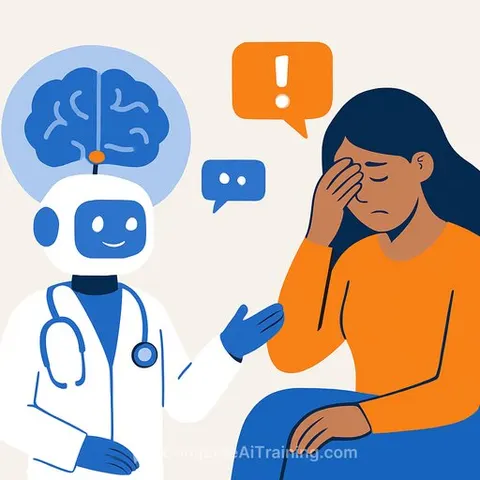
Mental Health Providers Turn to AI for Administrative Relief and Better Patient Care
More than 80% of physicians now use AI routinely in practice, according to a survey from the American Medical Association released last month. Seven in 10 see the technology as a way to reduce work-related burnout, while 76% believe it can improve patient care.
The shift reflects a broader acceptance of AI in mental health settings. One in eight U.S. adolescents and young adults use AI chatbots for mental health advice, according to research from the Rand Corporation. OpenAI reports that one in four of its 800 million regular users submits a prompt about healthcare each week.
Providers across different organizational sizes are already deploying these tools. Smaller practices like the Texana Center in Texas use AI for transcription, session notes, and automated intake data processing. The payoff is concrete: physicians currently spend 35% of their time on clinical documentation. When AI handles these tasks, providers reclaim time to spend with patients.
Larger health systems are moving beyond administrative automation. Centerstone, a nonprofit provider network, partnered with an AI company to offer real-time coaching for Cognitive Behavioral Therapy and Dialectical Behavioral Therapy across Certified Community Behavioral Health Clinics nationwide.
Intermountain Health, the largest nonprofit health system in the Intermountain West, has over 300 AI projects underway. One partnership uses algorithms to identify primary care patients at highest risk of suicide, allowing clinical teams to prioritize urgent cases.
The Risk of Unequal Access
A divide is emerging between large providers with robust data infrastructure and smaller ones without it. Large health systems can leverage structured and unstructured data to maximize AI benefits. Smaller providers, often in rural areas, lack the same capabilities.
Both groups have opportunities to benefit. The key is matching the right tools to organizational size and resources. Smaller practices can focus on administrative automation. Larger systems can tackle clinical decision-making and outcomes monitoring.
What Comes Next
AI in mental health requires careful implementation, regulation, and human oversight. The 43 million Americans experiencing a mental health condition each year represent both an urgent need and a clear rationale for providers to adopt these tools thoughtfully.
For more on how AI is reshaping healthcare delivery, see AI for Healthcare and AI Agents & Automation.