AI Accelerates OLED Material Discovery, Improving Design and Efficiency
Artificial intelligence is transforming the discovery process for organic light-emitting diode (OLED) materials. Traditional empirical methods, which rely heavily on expert intuition and incremental molecular modifications, are often slow and costly. In contrast, AI leverages machine learning (ML) and high-throughput virtual screening (HTVS) to efficiently explore an immense chemical space—estimated to contain between 1023 and 1060 possible compounds.
Industrial platforms like Kyulux’s Kyumatic™ system are already applying these AI techniques, scanning libraries with over one million candidate molecules. By combining quantum chemistry calculations with ML models, these systems predict molecular properties and guide targeted material design, significantly shortening development timelines.
Advancements in OLED Technology
Over the last 30 years, OLED materials have evolved from simple fluorescent emitters to advanced phosphorescent and thermally activated delayed fluorescence (TADF) systems. The latest multiple resonance-type TADF (MR-TADF) materials have pushed theoretical internal quantum efficiencies close to 100%, with external quantum efficiencies exceeding 20% for red, green, and blue devices.
Despite these improvements, achieving simultaneously high efficiency, long operational lifetimes, and precise color purity remains challenging. This limits OLEDs from reaching their full potential, especially for ultra-high-definition displays that demand exacting performance standards.
Limitations of Conventional Development Methods
The conventional approach to OLED material development depends largely on trial-and-error and modifying known molecular scaffolds. This slows progress and restricts exploration within the vast chemical space necessary for next-generation displays. Incremental changes to core structures often fail to meet the increasingly stringent requirements for efficiency and color accuracy.
Given these constraints, data-driven methods powered by AI present a promising alternative. AI can analyze large datasets and uncover complex structure-property relationships that are difficult to detect using traditional methods.
How AI Enhances Molecular Design
Advanced ML frameworks, including predictive algorithms and deep learning (DL)-based generative models, enable both forward and inverse molecular design. These tools have proven effective in fields like battery materials and catalysts, and they are now making an impact on OLED material discovery by improving molecular design and property prediction.
HTVS integrated with ML drastically reduces the number of experimental candidates. For example, Kyulux’s Kyumatic™ system screens over one million molecules, increasing hit rates and cutting discovery time. Similar strategies in pharmaceuticals have reduced preclinical timelines by up to 60%, suggesting comparable efficiency gains are achievable for OLED materials like blue TADF emitters.
Comprehensive Framework for AI-Driven OLED Discovery
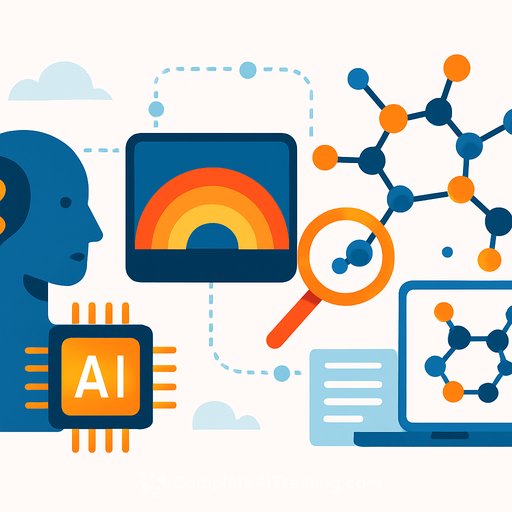
- Quantum Chemistry Calculations: Provide molecular descriptors not easily accessible experimentally, essential for modeling organic luminescent systems.
- Machine Learning Strategies: Enable accurate prediction of molecular properties using high-quality datasets from experiments, calculations, or databases.
- Deep Learning-Based Generative Models: Coupled with HTVS and inverse design, these models facilitate targeted molecular discovery by prioritizing candidates based on predicted properties.
This integrated framework allows researchers to move beyond empirical methods, systematically exploring vast chemical spaces and accelerating material discovery.
Challenges in Data Acquisition and AI Application
High-quality experimental datasets in OLED research are limited by the complexity, cost, and time required for molecular synthesis and device fabrication. Quantum chemistry calculations offer a practical alternative by generating reliable data for training ML models. These models transform molecular structures into AI-readable formats, forming the backbone of screening workflows.
By rapidly estimating properties across millions of compounds, AI-driven screening and generative design narrow the search space efficiently, enabling data-driven decisions rather than solely experimental trial-and-error.
A Cross-Disciplinary Perspective
The methods applied to OLED discovery borrow from more mature AI-driven fields like drug discovery and materials informatics. This cross-disciplinary approach leverages validated techniques to tackle OLED-specific challenges, speeding up innovation.
For those interested in expanding their AI expertise in scientific research, exploring specialized AI courses can be valuable. Resources like Complete AI Training’s job-focused courses offer practical learning paths tailored to various research domains.
Conclusion
Integrating quantum chemistry with machine learning marks a significant step forward in OLED material discovery. This approach addresses the limitations of traditional empirical methods by enabling rapid and systematic exploration of an enormous chemical space. AI-powered predictive models and generative design streamline the identification of promising molecules, improving efficiency and precision in OLED development.
As AI techniques continue to mature, their application in OLED research is set to enhance materials discovery, ultimately supporting the advancement of display technologies with better performance and reliability.
Your membership also unlocks: