The Evolution of Risk Management in Finance
Financial markets today are more unpredictable than ever. The speed of information flow, the scale of leverage, and the complexity of global connections have changed how risk behaves. Market shocks now arise from diverse triggers: geopolitical conflicts, algorithmic flash crashes, liquidity shortages, supply chain hiccups, and even social media-driven investor moods.
Traditional risk management frameworks, built on historical data, backward-looking models, and human judgment, struggle to keep up. These systems have long been the backbone of institutional oversight but have clear limitations:
- They react after risks materialize instead of anticipating them.
- They assume markets behave in linear, predictable ways, which is increasingly inaccurate.
- They adapt slowly, relying on infrequent recalibration and limited data.
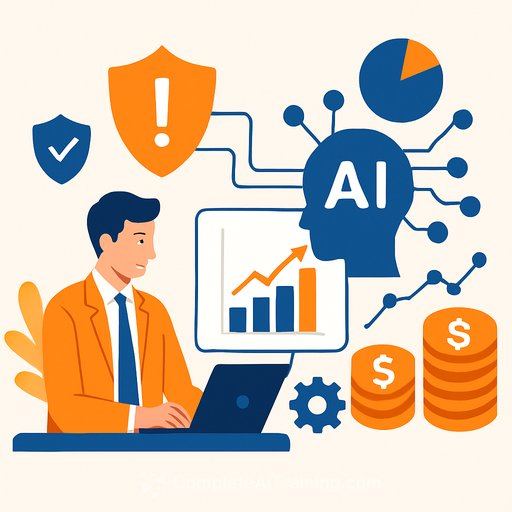
In an environment marked by high-frequency volatility and interconnected risks, a shift in approach is essential. Artificial Intelligence (AI) offers a way to transform risk management from a passive compliance exercise into an active, strategic function. AI enables systems to:
- Process vast amounts of structured and unstructured data from diverse sources simultaneously.
- Detect early warning signs and anomalies before they escalate.
- Forecast not just the likelihood of risk events but how they spread through markets and instruments.
- Act autonomously to adjust exposures, rebalance portfolios, or trigger hedges quickly and precisely.
This shift is about more than automation; it’s about intelligence at scale. AI-powered risk systems become anticipatory, adaptive, and continuous. For institutional investors, asset managers, and trading firms, the question is no longer if AI should be part of risk management, but how effectively it can be implemented to spot and prevent crises before they happen. Risk today doesn’t warn — it opens a narrow window. Only intelligent systems can see it in time.
From Reactive Models to Proactive Intelligence
For decades, financial institutions have relied on foundational models to quantify risk and uncertainty. These include:
- Value at Risk (VaR): estimating potential portfolio losses over a set timeframe with a confidence level.
- Stress testing: simulating portfolio outcomes under extreme but plausible scenarios.
- Beta and correlation coefficients: measuring sensitivity to market moves and relationships between assets.
- Scenario analysis: projecting outcomes based on historical events or expert assumptions.
While these tools remain vital, they share a key drawback: they are reactive. They assume future market behavior will mirror the past. But modern risks often break from historical patterns:
- Geopolitical shocks like Russia’s invasion of Ukraine or U.S.-China trade tensions.
- Technological failures such as algorithmic flash crashes.
- Liquidity fragmentation across decentralized and alternative trading venues.
- Sudden regulatory shifts with systemic impact (e.g., Basel III, DORA, MiCA).
In this shifting environment, relying solely on historical data leaves institutions vulnerable. AI, through machine learning, deep learning, and probabilistic modeling, brings a significant upgrade. It moves risk management beyond past data, enabling real-time intelligence and adaptive forecasting. AI systems can:
- Absorb vast unstructured data — news, regulatory filings, macro indicators, social sentiment, satellite imagery, and supply chain info.
- Identify complex, nonlinear relationships invisible to traditional models.
- Continuously monitor market behavior, asset classes, and investor sentiment, flagging early signals of disruption.
- Initiate proactive risk responses like rebalancing portfolios or adjusting hedges before human teams can react.
Unlike static models updated periodically, AI models learn and evolve continuously, recalibrating based on ongoing market realities.
Case in Point
In January 2020, as COVID-19 began spreading, AI-powered hedge funds detected weak signals well before traditional players reacted. They noticed rising sentiment volatility on Chinese social media, anomalies in flight cancellations and port activity in East Asia, and keyword spikes in earnings calls related to supply chain risks and the pandemic.
These AI systems, trained on alternative data, prompted early reductions in exposure to Asian equities, airlines, and travel-related stocks weeks before market sell-offs. While human teams were still processing official announcements, AI had already started reallocating capital.
This example highlights a critical insight: AI doesn’t just respond to risk; it anticipates it. In markets where milliseconds count, early detection isn’t optional — it’s necessary.
Your membership also unlocks: