
AI news ·
AI translation app helps Nigerian pilgrims communicate with Arabic-speaking bus driver during 2026 Hajj journey
An AI translation app ended a standoff between Arabic-speaking bus driver and Nigerian pilgrims during Hajj after communication broke down at 2 a.m. The incident shows real-time AI translation working under pressure when no interpreter is available.
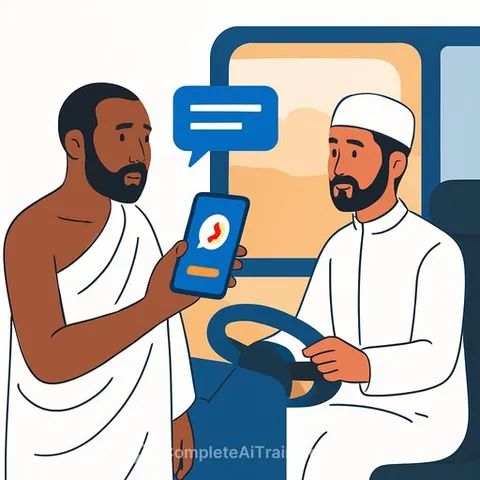
AI Translation Tools Solve Real Problem During Saudi Hajj Operations
Language barriers delayed a bus of Nigerian pilgrims traveling from Madinah to Makkah during the 2026 Hajj, but an AI-powered translation application resolved the standoff in minutes.
Around 2 a.m., the vehicle stopped unexpectedly for nearly an hour. When pilgrims approached the driver at 3 a.m. to ask why, communication broke down immediately - the driver spoke only Arabic, while most pilgrims spoke English and Nigerian languages.
An AI translation app with voice-to-text and instant translation features bridged the gap. The driver explained the delay through the application, pilgrims voiced their concerns, and both parties understood each other clearly before the journey resumed.
The bus arrived in Makkah around 4 a.m., where a second issue emerged: some accommodation cards listed hotel details that didn't match the actual drop-off location. Officials and coordinators spent time verifying correct destinations before directing pilgrims appropriately.
What This Means for Communications Professionals
The incident illustrates a practical use case for AI in large-scale operations involving diverse populations. When thousands of pilgrims from different countries converge in one location, language becomes a logistical problem - not just a cultural one.
For PR and communications teams managing multi-stakeholder environments, the lesson is direct: AI tools can handle real-time translation during crises or high-pressure situations. Real-time translation also reduces anxiety among affected parties by enabling clear, immediate explanations.
The Hajj experience also highlights a secondary communications challenge: coordinating information across systems. The hotel accommodation mismatch suggests that data accuracy matters as much as translation capability when managing large groups.
The Broader Context
Hajj brings roughly 2 million pilgrims annually to Saudi Arabia, speaking hundreds of languages. Technology firms have increasingly embedded AI translation solutions into pilgrimage operations to reduce friction at checkpoints, accommodations, and transport hubs.
For communications professionals, the takeaway is straightforward: AI translation is no longer theoretical. It works in high-stress, time-sensitive situations where traditional interpreters aren't available. Understanding how these tools function - and their limitations - is becoming essential for anyone managing communications in complex, multilingual environments.