
AI news ·
AI upskilling fails without redesigning the workflows it is meant to improve
AI upskilling fails when broken workflows stay in place. Training staff on new tools without fixing fragmented processes adds complexity, not efficiency.
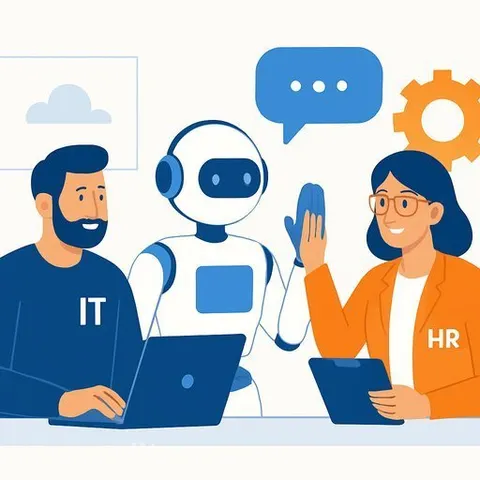
AI Upskilling Fails When Workflows Stay Broken
Organizations are training IT technicians on AI tools without fixing the broken workflows those tools are supposed to improve. The result: automation layered onto fragmented processes adds complexity instead of reducing it.
Nearly half of employees spend more than 20% of their workday on meta-work-navigating processes, chasing approvals, resolving system issues. Adding AI on top of that friction doesn't solve the underlying problem.
Real AI value requires more than tool training. It demands rethinking workflows, decision-making structures, and team responsibilities alongside the technology itself.
The Misconception: Tools Are Enough
Most organizations treat AI upskilling as a software training problem. Learn the interface. Learn the workflow. Done.
That misses the harder work: teaching technicians when to trust automation, when to step in, and when to escalate. Without that operational judgment, trained teams hesitate at critical moments, and AI never delivers its full potential.
Hands-on practice builds this judgment faster than classroom training. Technicians who work with AI systems in simulated environments, sandbox setups, and peer-led walkthroughs gain confidence without risking live-system errors.
The real skill to develop is prompt literacy-asking the right questions, providing proper context, and interpreting AI responses critically. Technicians who master this see immediate results.
Workflows Must Shift First
Even well-trained technicians can't fix broken processes. Sixty-one percent of employees report delaying or avoiding action because workflows are too complex or unclear. Add AI without redesigning those workflows, and automation amplifies friction instead of reducing it.
Start with high-friction areas: ticket triage, escalation handling, routine troubleshooting. These are repetitive, time-consuming, and prone to inconsistency. Redesign one workflow end-to-end before layering in AI.
Take ticket management. AI can triage incoming tickets, flag anomalies, and resolve common issues automatically. The technician's role shifts from processing every task to reviewing AI actions, handling high-priority cases, and improving the system over time.
But someone must own AI performance in production. Without clear accountability for monitoring outputs, adjusting rules, and ensuring automation actually improves outcomes, AI creates as many problems as it solves.
Redefine Roles and Metrics
As workflows evolve, team structures and performance metrics must too. Traditional KPIs-ticket volume, resolution time-no longer capture the full picture.
Track behaviors alongside outcomes: How often are automated resolutions accepted versus overridden? Where do technicians step in, and why? Which workflows escalate despite automation?
Monitor both AI performance (automation success rates, override frequency, escalation patterns) and human judgment (how effectively technicians manage anomalies and apply critical thinking). Resolution time still matters, but not alone.
Define roles clearly. As AI handles routine execution, technicians shift toward oversight, analysis, and strategic improvement. Clear ownership of decisions, exceptions, and system performance builds trust in AI-enabled workflows.
Integration Matters More Than Features
AI that spans disconnected tools or dashboards adds friction. Effective systems integrate directly into platforms technicians already use, not bolted on as a separate interface.
Technicians need context where they need it, without breaking their workflow. That design choice-embedded versus separate-determines whether AI multiplies efficiency or creates extra work.
AI Amplifies Human Judgment
Upskilling is foundational, and it must be ongoing. Technicians who develop operational judgment, understand workflows, and manage exceptions provide the foundation for meaningful AI integration.
Working effectively with AI-crafting prompts, interpreting recommendations, deciding when to act or override-is now a core IT competency. AI handles execution. Humans focus on judgment, refining workflows, and driving outcomes.
Organizations seeing the most value from AI aren't necessarily those investing the most in training. They rethink how work happens and equip teams to operate differently with the technology.
Consider exploring AI learning paths for IT managers to align strategy with execution, or resources on AI agents and automation to understand workflow redesign in practice.
Technicians who embrace AI fluency resolve issues faster and advance their careers in an AI-first environment. This isn't about replacement. It's about making human judgment more powerful.