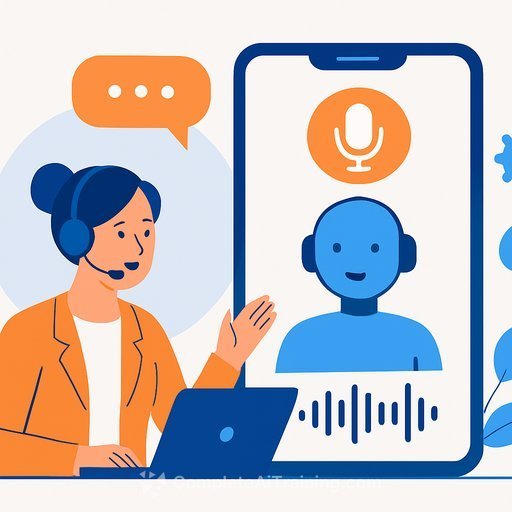
AI won't kill customer support jobs. It might make them more valuable.
There's a lot of talk about AI replacing support teams. Gartner doesn't buy it. Their new analysis says the cost of generative AI per resolved issue will top $3 by 2030-often more than the cost of a human agent in offshore locations.
Translation: full automation won't be the cheap silver bullet many expected. The smart move is using AI to improve the experience, not gut headcount.
What Gartner predicts
Gartner expects generative AI costs in support to rise, not fall. The drivers:
- More expensive data center and compute requirements
- Current vendor subsidies fading as profit pressure kicks in
- More complex use cases that eat resources and demand scarce specialists
"Customer service leaders are determined to use AI to reduce costs, but return on those investments is far from guaranteed," said Patrick Quinlan, senior director analyst at Gartner. "Full automation will be prohibitively expensive for most organizations; instead, leading organizations will use AI to drive customer engagement rather than to cut costs."
Regulatory shifts will also push volume up. Gartner expects a 30% increase in supported services by 2028 as customers exercise the right to a human. Many companies may even rehire agents-potentially at higher pay-to keep wait times and experience in check.
A 2025 Gartner survey of 321 service leaders backs this up: only 20% reduced staff due to AI; most kept headcount stable because they're serving more customers. As Gartner's Emily Potosky notes, the tech isn't mature enough to replace expertise, empathy, and judgment. "Relying solely on AI now is premature and could lead to unintended consequences."
What this means for support leaders
If you run support, assume AI is a force multiplier for people-not a pink slip machine. Reframe your strategy around value creation and resilience.
- Prioritize experience over pure deflection. Use AI to speed resolution, personalize help, and reduce effort. Track lifetime value, repurchase, and loyalty alongside AHT and CSAT.
- Design for human-in-the-loop. Let AI triage, summarize, suggest, and route. Make escalation to a person fast and obvious. Honor "right to human" without friction.
- Budget for real costs. Model token/compute usage, latency trade-offs, vendor markups, and compliance overhead. Compare cost-per-resolution to human benchmarks by issue type.
- Invest in knowledge. Keep your knowledge base fresh. Use retrieval to feed agents and bots the exact paragraph, not a 20-page doc.
- Tighten governance. Add content QA, safety policies, review queues, and audit trails. Document handoffs and disclosures for regulatory readiness.
- Upskill your team. Train agents for judgment-heavy work: exceptions, escalations, and de-escalation. Build roles in conversation design, knowledge ops, and quality.
Where AI delivers value today
- Agent assist: Draft replies, summarize threads, surface next best actions.
- Smart routing and intent detection: Get issues to the right queue faster.
- Post-interaction summaries: Automate notes and CRM updates.
- Knowledge suggestions: Recommend exact snippets to resolve edge cases.
- Quality monitoring: Score interactions and flag risk without hours of manual review.
Go easy on fully autonomous agents for complex cases. They're costly, brittle, and risky for brand trust.
Build a realistic ROI model
- Segment by intent: Top 50 issues, volume, complexity, current cost-per-resolution.
- Set automation tiers: Informational (deflect), transactional (assist), complex (human-led).
- Track both cost and value: AHT, FCR, CSAT, containment quality, refunds avoided, retention and LTV uplift.
- Include failure costs: Escalation delays, recontacts, churn from poor bot experiences.
Prepare for "right to human"
- Offer a clear handoff within two steps, any channel.
- Staff queues to absorb a 30% volume bump without long waits.
- Publish AI disclosures and maintain opt-out logs.
Your 90-day action plan
- Weeks 1-2: Audit intents, map tiers, baseline costs and CSAT by channel.
- Weeks 3-6: Pilot agent assist and post-call summaries. Target 10-20% AHT reduction with no CSAT drop.
- Weeks 7-10: Add smart routing and knowledge suggestions. Set strict guardrails and fast human fallback.
- Weeks 11-12: Review ROI, adjust staffing, publish governance docs, and plan the next pilot.
Metrics that matter
- Cost per resolution (AI vs human) by intent
- Quality-adjusted containment and escalation rates
- Wait time to human and resolution time end-to-end
- CSAT/NPS by channel and intent complexity
- Retention, repurchase rate, and LTV after assisted interactions
The bottom line
AI won't replace your support team. It will raise the bar. Costs are rising, regulation is tightening, and customers want a human available-fast.
Win by pairing AI with skilled agents, measuring what actually moves revenue and loyalty, and building the ops muscle to deliver consistent, human outcomes at scale.
Want practical training for your team? Explore AI for Customer Support and the AI Learning Path for Call Center Supervisors.
Your membership also unlocks: