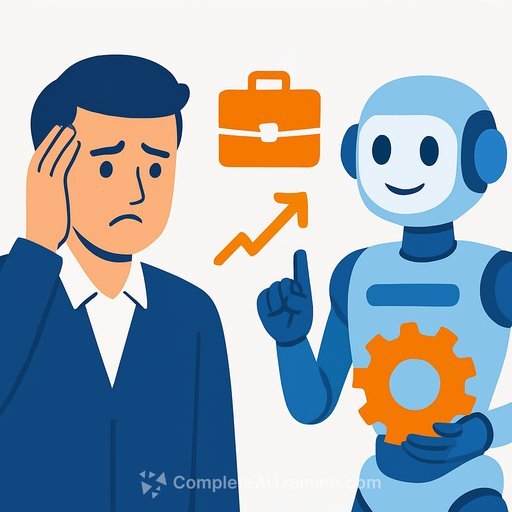
AI Won't Sell Itself: HR Has to Lead the Adoption
Buying AI tools is the easy part. Getting people to actually change how they work is the real job, and it sits with HR and frontline managers, not just IT.
Recent Gartner research found a gap: 46 percent of managers are experimenting with AI, but only 26 percent of employees are. Only 14 percent of managers said they faced no challenges getting their teams to adopt AI. Translation: without structured change management, adoption stalls.
Why this is HR's job
AI creates workflow changes, role shifts, and new expectations. That triggers operational and emotional resistance if left unmanaged. HR is uniquely positioned to set policy, prepare managers, and communicate clearly to employees and executives.
There's also public skepticism to consider. A recent Data for Progress poll found 46 percent of US voters believe AI will hurt the economy. If leaders ignore that sentiment, they'll run into quiet pushback or outright refusal to use the tools.
What HR should do this quarter
- Segment by team and task: Identify 3-5 priority use cases per function (e.g., drafting emails, summarizing meetings, first-pass research, reporting).
- Define the working agreement: What AI can be used for, what's off-limits, how outputs are reviewed, and where data should never be pasted.
- Train managers first: Give them the "why," example workflows, and talk tracks to handle fear, quality concerns, and workload questions.
- Pilot, then scale: Run 4-6 week pilots with clear success metrics. Publicize wins, fix friction, expand in waves.
- Set the time policy upfront: Clarify how saved time is redeployed so people don't assume "do more with less" means "your job is at risk."
- Align with executives: Reset expectations on timelines, adoption curves, and what "productivity" looks like in the first 90 days.
Handle emotional resistance head-on
- Decouple AI from layoffs: If possible, make and communicate a time-bound commitment (e.g., no AI-related headcount actions for 6-12 months).
- Use opt-in pilots with guardrails: Volunteers first, then broaden. Early adopters become peer coaches.
- Quality reassurance: Require human review for external content and critical decisions. Share before/after examples to prove standards hold.
- Psychological safety: Normalize "AI got it wrong" moments. Track and fix failure modes without blame.
Decide how to use time saved, before you save it
Only 7 percent of organizations provide guidance on how to use time freed by AI, according to Gartner. That vacuum creates anxiety and stalls adoption.
There's also a split in priorities: 55 percent of HR leaders want time savings redirected to projects outside core roles, while only 28 percent of managers agree. Resolve this with a simple rule of thumb (for example: 50 percent to core work quality, 30 percent to improvement projects, 20 percent to learning and innovation) and make it policy.
Metrics executives will respect
- Adoption: Percentage of team using AI weekly; active days per week per user.
- Coverage: Share of targeted tasks now AI-assisted.
- Throughput and quality: Cycle time reductions, error rates, rework.
- Employee sentiment: Confidence using AI, perceived workload, clarity on expectations.
- Risk and compliance: Incidents, policy adherence, data exposure prevented.
- Time redeployment: Hours saved and where they were reinvested.
A simple 30/60/90 plan
- Days 0-30: Pick 3-5 use cases per function. Draft policy and working agreements. Train managers. Launch two small pilots.
- Days 31-60: Expand pilots. Collect baseline vs. after metrics. Host weekly office hours. Share two internal case studies.
- Days 61-90: Roll out to the next wave of teams. Lock the time-savings policy. Publish a short adoption dashboard for executives.
Equip managers with a starter kit
- Use case playbooks: Step-by-step workflows with prompts, examples, and review checklists.
- Prompt libraries: Approved prompts for common tasks; team can add and upvote.
- Communication scripts: Kickoff email, "why now" deck, FAQ on jobs, quality, and data.
- Office hours and champions: Named point people and a weekly forum for questions and demos.
- Recognition: Highlight wins and share the time-savings reinvestment stories.
Guardrails that reduce risk
- Data rules: No confidential or regulated data in public tools. Use approved systems only.
- Review rules: Human review for anything external-facing or high impact.
- Usage rules: Document sources, note AI assistance, and keep an audit trail for key decisions.
- "Don't use AI for" list: Performance ratings, sensitive employee issues, and any legal or safety-critical calls.
Bottom line
AI adoption is less about tooling and more about management. If HR sets the policy, prepares managers, and makes a clear plan for time savings, employees will use the tools-and keep using them because it makes their work better.
Resources
Your membership also unlocks: