
AI news ·
AIJRF and University of Dubai launch agentic AI initiative to train 1,000 educators
A new UAE initiative will train 1,000 educators to build autonomous AI agent teams by 2026. The two-day course focuses on hands-on creation of digital classroom assistants.
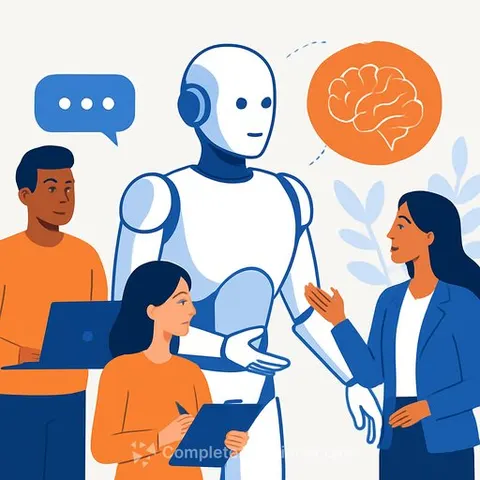
The Artificial Intelligence Journalism for Research and Forecasting (AIJRF) and the Arab Index for Artificial Intelligence in Universities (AIU) at the University of Dubai have launched the Agentic AI for Educators Initiative (AAEI). The program aims to train 1,000 university faculty members and school teachers in the United Arab Emirates in practical Agentic AI skills by the end of 2026. It is the first specialized training initiative in the region focused on moving educators from using off-the-shelf AI tools to building and managing autonomous AI agent teams.
"Educational institutions worldwide are moving beyond the use of traditional AI tools toward building intelligent educational ecosystems powered by autonomous AI agents capable of executing tasks independently and collaborating with one another," said Dr. Mohamed Abdulzaher, CEO of AIJRF.
He added: "Our objective is to equip university professors and teachers with the knowledge and practical skills required to integrate Artificial Intelligence and Agentic AI into everyday teaching. We aim to enable educators to build intelligent AI Agent Teams that support curriculum development, lesson planning, assessment management, scientific research, and classroom innovation, ultimately improving educational quality and academic productivity."
What the training covers
The program teaches participants to design, build, and manage complete AI agent teams that function as digital assistants for a range of academic tasks. These include curriculum development, lesson preparation, assessment design, scientific research, academic administration, student engagement, and personalized learning.
Unlike courses that focus only on using existing AI applications, the AAEI emphasizes hands-on creation of autonomous workflows. Each participant leaves with their own set of deployed AI agents and a fully built educational AI workflow.
Program structure and delivery
The training runs over two intensive days, totaling six hours of practical work. Participants use five specialized Agentic AI tools and complete one applied project. The model is 20% theory and 80% hands-on implementation.
Target audiences include university faculty, school teachers, academic leaders, program directors, curriculum developers, instructional designers, educational supervisors, and researchers.
Skills participants gain
- Design and develop educational AI agents
- Build collaborative AI agent teams for classrooms
- Automate routine teaching tasks
- Develop intelligent assessment systems
- Design smarter curricula and academic courses
- Integrate AI professionally into classroom teaching
- Build a customized educational AI ecosystem
Many educators have already started experimenting with AI in the classroom through platforms and courses, such as those focused on AI for Teachers. The AAEI builds on that foundation by introducing agentic systems that can operate independently and in teams.
Why this matters for educators
The shift to Agentic AI changes what educators need to know. Instead of learning to prompt a single chatbot, they learn to orchestrate multiple AI agents that handle different parts of their workload. This program gives teachers and professors a practical path to building those systems themselves, rather than waiting for institution-wide deployments. For faculty and teachers in the UAE, the initiative offers a direct, structured way to gain skills that will soon be required to stay current in digital-first classrooms.