Airbnb Shifts 33% of Support to AI in the US and Canada
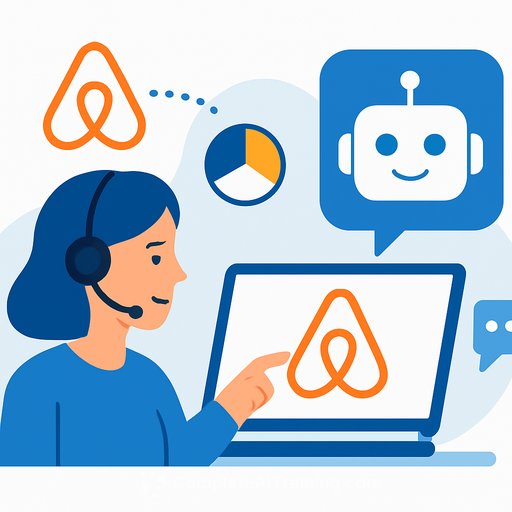
Airbnb says its in-house AI now resolves about a third of support requests in the US and Canada across chat and voice. The company is preparing to take the model global and expects it could clear 30%+ of tickets worldwide within a year as more languages and markets come online.
For customer support leaders, this is a clear signal: high-frequency, policy-bound conversations are moving to automation at scale. The question is no longer "if," but "how cleanly you can implement, measure, and govern it."
How Airbnb's AI Concierge Works
The agent handles common booking and stay issues end to end, then escalates tough cases to human specialists. Think fast, consistent answers on predictable tasks, with clear handoffs when nuance or stakes rise.
- Check-in logistics and access details
- Billing clarifications and price breakdowns
- Date changes and simple reservation edits
- Basic refund eligibility checks
By front-loading these interactions with automation, Airbnb reports shorter response times and lower operating costs. The intent is speed without sacrificing accuracy.
Why Leadership Is Calling It a Quality Play
Airbnb argues the agent outperforms humans on routine requests because it runs on a proprietary corpus. That includes more than 200 million verified identities, over 500 million reviews, and a messaging graph where roughly 90% of guests contact hosts.
With that closed-loop data, the AI can see context, check policies, ping a host, and even initiate refunds. Generic chatbots can't easily replicate those actions or the platform context behind them.
Airbnb's AI-Native Roadmap
New CTO Ahmad Al-Dahle, a veteran of Apple and former leader of the team behind Meta's Llama models, is steering an "AI-native" strategy beyond support. The vision: a more conversational app that "knows" the traveler, helps plan trips, and gives hosts lighter-overhead tools.
Internally, about 80% of engineers already use AI tooling, with a push toward near-universal adoption to boost velocity. Search is an early testbed: a small slice of traffic now sees natural-language discovery, with sponsored placements set to follow. If conversational search proves sticky and relevant, the path from intent to booking compresses-Airbnb says it is already seeing stronger conversion from AI-driven top-of-funnel traffic than traditional search.
What It Means for Support Teams
For guests, the near-term gains are faster resolutions, 24/7 availability, cleaner handoffs, and fewer back-and-forths on predictable issues. For hosts, less time untangling policy questions or minor changes means more focus on service and revenue.
The critical nuance is escalation. Complex, sensitive, or high-dollar scenarios still route to humans, where judgment and empathy matter.
- Track by language: first contact resolution (FCR), CSAT, and error rates as new locales roll out.
- Audit tone and Translation: multilingual support wins only if clarity and fairness hold up.
- Hold the line on policy: let AI explain and apply rules, but verify edge cases with humans.
Competitive and Financial Context
Airbnb is guiding to low double-digit revenue growth and recently topped Wall Street expectations. Automation in service is one of the cleanest ways to expand margins without raising fees or degrading experience.
The company points to the depth of its operating moat: host and guest apps, identity verification, insurance protections, and a payments stack processing more than $100 billion annually. Even if general-purpose AI platforms steer more travel intent, Airbnb believes it can win on conversion once traffic lands-especially if its own AI reduces friction from inquiry to booking and resolves issues faster.
Benchmarks and Risks in AI-Powered Support
Others are seeing similar traction. Klarna reports its AI assistant handles the workload of hundreds of agents and resolves a majority of chats, while banks and airlines use AI triage to shrink queues and route calls.
Analysts at firms like Gartner and McKinsey cite customer service as a high-ROI foothold for generative AI, especially when domain-specific data guides decisions. Still, the risks are real: hallucinations, policy misapplication, and perceived unfairness in edge cases.
- Regulatory backdrop (US): the FTC urges companies to substantiate AI claims and maintain human review for consequential decisions. See the FTC's guidance on AI use here.
- Regulatory backdrop (Canada): PIPEDA requires clear data handling and transparency. Reference from the Office of the Privacy Commissioner of Canada here.
- Scale risk: a systematic AI error can cascade quickly without monitoring and swift human escalation.
What to Watch Next
- Sustained improvements in response time, FCR, and CSAT alongside lower cost per ticket.
- Accuracy and tone as the agent expands into more languages and policy-heavy scenarios.
- Evidence that 30%+ of global support can be automated without denting trust or fairness.
A Practical Playbook for Support Leaders
- Map your top intents: identify the 20-40 high-frequency issues that drive the bulk of volume.
- Wire in first-party data: bookings, policies, identity, prior messages, entitlements, refunds.
- Stand up triage: detect risk, language, sentiment, and route by policy and proficiency.
- Codify policy: turn rules into a decision engine; log rationale for every action.
- Define escalation paths: set hard stops by dollar thresholds, safety issues, and repeat contacts.
- QA and red-team: test edge cases, run hallucination checks, and sample conversations daily.
- Localize the right way: human-in-the-loop review for new languages until metrics stabilize.
- Measure what matters: FCR, CSAT, AHT, recontact rate, refunds per contact, and policy variance.
- Train your people: coach agents to supervise AI, handle escalations, and correct policy drift.
- Governance: audit trails, consent and data retention, model change logs, and rollback plans.
If you're upskilling a support org for AI-assisted operations, you may find these curated learning paths useful: AI Learning Path for Training & Development Managers and AI Learning Path for Sales Managers.
Your membership also unlocks: