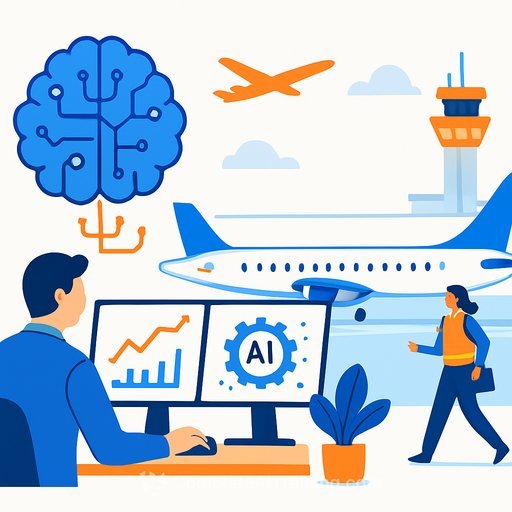
Airport Robots Market Forecast 2025-2034: What Operations Professionals Need to Know
The Airport Robots Market is set to grow significantly, valued at USD 2.1 billion in 2025 and expected to reach USD 7 billion by 2034. This represents a compound annual growth rate (CAGR) of 14.4%. For those working in airport operations, this growth signals a shift towards increased automation in cleaning, security, and passenger assistance.
Demand for robotic systems is driven by the need to improve operational efficiency, enhance passenger experience, and reduce costs. Robots equipped with advanced AI and machine learning capabilities are becoming essential tools for airport operators aiming to streamline processes and maintain high standards of safety and hygiene.
Key Trends Shaping Airport Robotics
- AI-Driven Automation: AI algorithms are improving cleaning and security tasks, allowing robots to operate more effectively and autonomously.
- Passenger Assistance Robots: Enhanced navigation and communication functions help guide passengers smoothly through terminals.
- Machine Learning Advances: Better object detection and threat identification make security robots more reliable.
- Contactless Solutions: Minimizing human contact supports hygiene protocols, an essential focus since 2024.
- Quantum Computing: Expected to optimize robot routing and scheduling in the near future, reducing delays and boosting efficiency.
Technological innovations in sensor networks and AI contribute to more reliable and scalable robotic systems. However, challenges remain in integrating these technologies with existing airport infrastructure, ensuring data interoperability, and meeting strict safety regulations.
Market Segmentation and Growth Opportunities
The market is segmented by type, application, end user, and geography:
- By Type: Non-Humanoid robots dominate current deployments.
- By Application: Terminal operations see the most robot usage.
- By End User: Includes boarding pass scanning, baggage handling, and passenger guidance.
- By Geography: North America, Europe, Asia-Pacific, Middle East, Africa, South and Central America.
Operations teams should monitor developments in these areas to align their strategies with emerging robotic capabilities and regional trends.
Looking Ahead: Innovations and Collaboration
Advancements expected beyond 2025 include the use of blockchain technology to enhance data security and transparency. There is also a growing emphasis on making robotic solutions compatible with future airport designs and sustainability goals.
Collaborations between robot manufacturers, airport operators, and technology providers will be crucial. These partnerships aim to develop tailored robotic solutions that address specific operational challenges while maintaining safety and reliability.
Industry Players to Watch
Key companies active in this market include:
- ABB Ltd.
- Avidbots Corp.
- Cyberdyne Inc.
- ECA Group
- LG Corporation
- SITA
- SoftBank Group Corp.
- UVD Robots
- Honeywell International Inc.
- NEC Corporation
- Vanderlande Industries B.V.
- Stanley Robotics
- Boston Dynamics
- Clearpath Robotics
- Simbe Robotics
- And many others.
Staying informed about these companies’ developments can provide insights into the latest solutions available for airport operations.
Practical Takeaways for Airport Operations Professionals
- Invest in AI and machine learning knowledge to better manage robot deployments.
- Focus on integrating robotic systems with existing airport infrastructure smoothly.
- Prioritize safety and data security when adopting new robotic technologies.
- Explore partnerships with technology providers to customize solutions for your airport’s needs.
- Stay updated on emerging trends like quantum computing and blockchain as they become relevant.
- Consider sustainability principles when planning for robotic system expansion.
For those interested in expanding their skills in AI and automation technologies relevant to operations, resources are available at Complete AI Training.
Summary
The Airport Robots Market is growing rapidly, driven by the need for efficiency, safety, and cost savings in airport operations. AI-powered cleaning, security, and passenger assistance robots are becoming standard. Staying ahead means understanding these technologies, addressing integration challenges, and preparing for innovations on the horizon.
For detailed market data and projections, visit ResearchAndMarkets.com.
Your membership also unlocks: