
AI news ·
AI's biggest role in education is freeing teachers from admin, not replacing them
A.I. won't replace teachers, but it could take over the administrative work that consumes roughly half their time. The real question is whether schools use that to cut costs or give teachers more time with students.
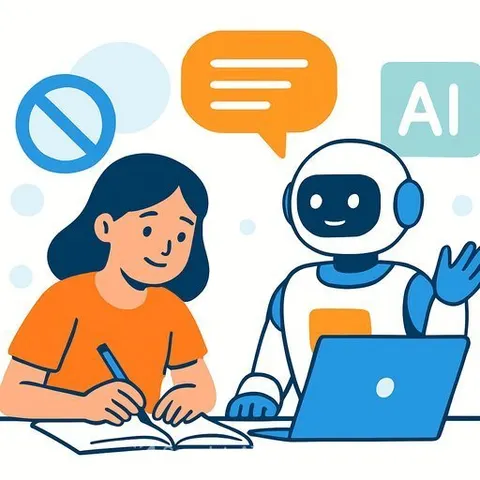
Stop Asking if A.I. Will Replace Teachers. Ask What It Should Do Instead
The wrong question dominates the conversation about artificial intelligence in schools: When will A.I. teachers fully replace humans?
The answer is never. But that question obscures a more useful one: How should schools use A.I. to free teachers from administrative work so they can do what only humans can do-motivate, inspire, and build relationships with students?
Every information revolution has reshaped teaching without eliminating it. When manuscripts were chained to desks in 16th-century Florence, the role of teachers changed. The printing press changed it again. So did the internet. A.I. will too.
Where A.I. Actually Excels in Schools
A.I. tools already work in classrooms. Khan Academy's Khanmigo and Google's A.I.-assisted features are in use globally. The technology can transcribe lessons, identify student mistakes, build personalized lesson plans, generate homework, and mark responses-all with no judgment or social pressure attached.
A.I. avatars can run live practice sessions that correct mistakes in real time. For self-directed learning, this is genuinely useful. Students get a low-stakes environment to fail safely.
But capability isn't the same as purpose. The question schools should ask is what A.I. is actually good at, not what it can theoretically do.
What Human Teachers Do That A.I. Cannot
MIT offers thousands of hours of free course materials online. The university still charges substantial tuition for human instruction. This tells you something important about what actually matters in education.
Teachers motivate students to try again after failure. A.I. can identify a mistake; a teacher can give you the reason to persist. Teachers judge when you need to be pushed beyond comfort, not coddled within it. They create a social contract of shared accountability that ChatGPT cannot replicate.
A student apologizing to a chatbot for incomplete homework carries no weight. Apologizing to a teacher does.
The Real Administrative Crisis
About 50 percent of school teachers' working hours in the U.K. go to administrative tasks: lesson prep, writing student guidance, setting assessments, general management. Self-employed tutors spend over 30 minutes on admin for every hour teaching.
Teachers say the time in the classroom gives them the most satisfaction. But for many, that proportion is far too low. Administrative burden is a leading driver of burnout and attrition across OECD countries.
This is where A.I. should focus. Student assessment, lesson preparation, and administrative tasks are precisely what the technology does well. Redirecting these to A.I. frees teachers to spend time on motivation, inspiration, social accountability, and calibrating challenge for individual students.
A Different Goal for A.I. in Schools
One approach to A.I. in education is essentially cost-cutting: reduce human staff, automate instruction, save money. Taken to its conclusion, this produces a less human system that is, paradoxically, less effective.
A better goal: use A.I. to bring more humanity to education. Combine the complementary strengths of human teachers and intelligent tools.
This means every learner has access to a great teacher. The relationship is personal. The curriculum is tailored to their needs and interests. Everyone is supported in pursuit of excellence.
For educators interested in understanding how to work effectively with these tools, resources on A.I. for Education and an A.I. Learning Path for Teachers can help clarify practical applications in your classroom or tutoring practice.
The decisions about how schools deploy A.I. are being made now. The question isn't whether the technology will change teaching. It will. The question is whether schools will use it to reduce costs or to reclaim the hours teachers spend on paperwork so they can teach.