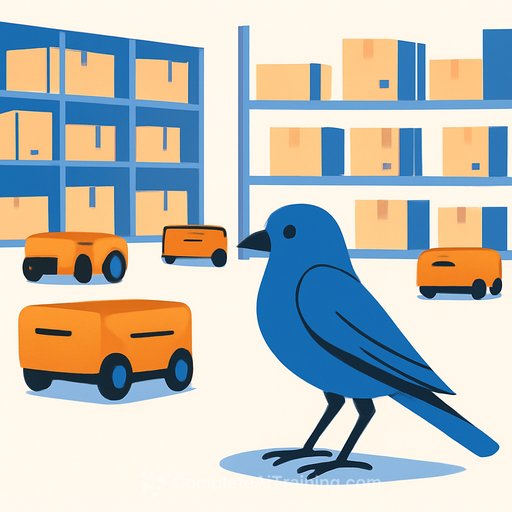
Amazon's Warehouse Robots Hit 1 Million Units-But Blue Jay's Collapse Shows Real Risks
Amazon operates more than one million robots across 300 facilities, managed by software that processes 750,000 routing decisions per second. The company is simultaneously cutting 30,000 jobs while investing record sums in robotics and data centers-a contradiction that reveals how automation reshapes rather than simply eliminates warehouse work.
The tension between efficiency and employment came into sharp focus when Amazon halted its Blue Jay prototype in March 2026. The ceiling-mounted robotic arms promised to pick 1,200 items per hour at urban fulfillment centers. Instead, they hit only 850 items per hour while costs spiraled beyond projections. At least 100 robotics engineers lost their jobs in the shutdown.
What the Numbers Actually Show
Amazon's DeepFleet software coordinates movement across dozens of machine types and has delivered throughput gains approaching 25 percent in high-volume facilities. Leaked planning documents suggested the company aimed to avoid hiring 160,000 workers by 2027-a figure Amazon disputes but analysts treat as evidence of aggressive automation timelines across retail supply chains.
Gartner forecasts global warehouse robotics spending will reach $51 billion by 2028, up from $22 billion today. Sixty-five percent of surveyed executives cite competitive pressure from e-commerce leaders when justifying these capital allocations. Early adopters gain shorter payback periods and stronger negotiating power with component suppliers.
The Workforce Question
Forecasts suggest Amazon could avoid hiring 600,000 U.S. workers by 2033. Company leadership frames robots as ergonomic aids that reduce repetitive lifting injuries. Workers fear reduced overtime and wage stagnation. Both concerns have merit.
Amazon expanded retraining grants and certificate reimbursements for displaced staff. Automation shifts job tasks rather than erasing positions entirely-but reskilling speed determines who benefits. Professionals who secure credentials in warehouse AI and robotics improve their mobility across emerging roles.
Why Blue Jay Matters
Blue Jay's cancellation illustrates a hard truth: prototype risk remains inherent to warehouse automation rollouts. The project launched in October 2025 with considerable fanfare. Supply chain volatility and integration complexity derailed it within months.
Tye Brady, Amazon Robotics technologist, said core Blue Jay algorithms would migrate to newer machines. That claim will be tested. The incident signals that monolithic systems face higher cancellation risk than modular designs with phased rollouts.
What Leaders Should Track
Successful automation programs emphasize agile engineering and transparent stakeholder engagement. Executives should monitor three critical indicators: throughput variance against projections, realized headcount savings versus attrition, and regulatory or union pushback intensity.
Budget trends confirm Amazon prioritizes scalable automation. Selective cuts signal disciplined capital allocation rather than wholesale retreat. Both camps of analysts expect deeper warehouse AI integration within two years.
Building Resilience
Technical managers require credible proof of robotics competence as automation accelerates. Certifications align vocabulary between engineers, operators, and executives. Project sponsors report faster vendor evaluations and shorter time-to-value after completing relevant coursework.
Organizations should integrate certification spending into transformation budgets. Hands-on facility rotations remain irreplaceable for line supervisors, but structured credentials strengthen talent pipelines across fulfillment centers undergoing change.
Warehouse Robot Automation sits at the intersection of engineering ambition and workforce anxiety. Cancelled prototypes like Blue Jay show experimentation remains messy yet essential. Throughput gains and ergonomic relief demonstrate undeniable value for fulfillment centers worldwide.
Leaders should pair phased rollouts with transparent communication and robust reskilling budgets. Tomorrow's most resilient teams will blend technical fluency, data insight, and human-centric leadership. Learn more about AI Agents & Automation and AI for Executives & Strategy to strengthen your organization's approach.
Your membership also unlocks: