Amazon's AI Push: What Managers Can Learn From an Employee Uprising
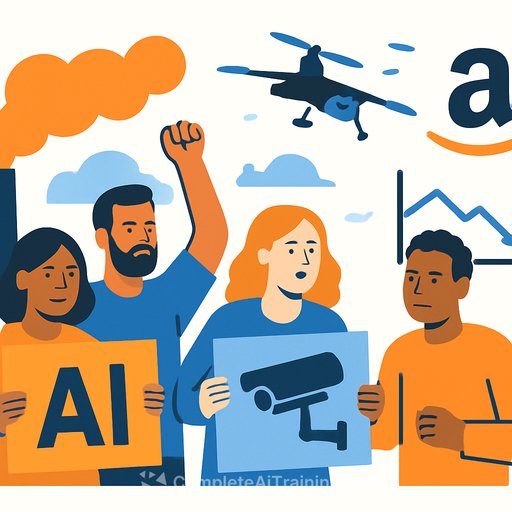
More than 1,000 Amazon employees issued an open letter warning leadership that the company's AI strategy is veering into dangerous territory. Their core claims: expanded surveillance, climate backsliding due to energy-hungry data centers, and accelerated job cuts through aggressive automation.
The letter points to specific actions: re-opening tools for police to request customer footage, using AI to monitor warehouse workers and customers, and partnering with an autonomous weapons software firm. They argue the sprint to build and sell AI could empower authoritarian practices at home and abroad.
They also challenged the company's environmental commitments. AI training and inference require massive compute, and hyperscale data centers can draw 100-500 megawatts each-akin to a small city. With more than 900 data centers and plans to build more, employees say the AI boom is widening the gap between the Climate Pledge and actual emissions, which they claim have risen roughly 35% since 2019.
Amazon disputes that it's backtracking. A company spokesperson said it remains committed to net-zero by 2040, leads on data center efficiency, and is the largest corporate buyer of renewable energy. The company highlighted investments in nuclear and SMR technology as part of its plan to decarbonize operations.
On jobs, employees cited internal documents suggesting a plan to automate 75% of operations and avoid hiring 160,000 roles within two years, alongside recent layoffs. Their lived experience, they say: higher output targets, tighter timelines, pressure to build AI for low-value use cases, and limited investment in career advancement.
What managers should do now
- Map your AI portfolio by risk: rights, safety, privacy, compliance, brand, and geopolitical exposure.
- Stand up cross-functional AI governance with clear decision rights and a genuine veto over high-risk deployments.
- Require model cards, data lineage, and usage boundaries for every system that impacts employees, customers, or citizens.
- Enforce human-in-the-loop (or human-on-the-loop) for materially consequential decisions.
- Do vendor due diligence for surveillance and defense tie-ins; add contractual limits on end-use and sub-licensing.
- Budget environmental impact: energy, water, and carbon using marginal emissions factors-then set reduction targets per workload.
- Plan for workforce change: identify automatable tasks, reskill at scale, and set a reinvestment policy for productivity gains.
- Create an AI incident response playbook and a protected whistleblower channel for ethical concerns.
Guardrails to codify in policy
- Red lines for use cases: no biometric or continuous worker monitoring without strict necessity, consent, and oversight.
- Audit logging for models that affect employment, access, pricing, credit, or safety.
- Privacy by default: data minimization, short retention, encryption, and clear opt-outs for customers and employees.
- Third-party red-teaming, bias and robustness testing before and after deployment.
- Transparency reports covering government requests, safety incidents, and material model changes.
- Energy and carbon thresholds per project; pause criteria if you exceed them without mitigation.
KPIs that make AI accountable
- Energy per 1,000 inferences and per training run; water use for cooling where relevant.
- Carbon intensity by region and workload; percentage of compute on firmed low-carbon power (including nuclear).
- Rate of human overrides on high-impact decisions; incident detection-to-mitigation time.
- Reskilling participation and redeployment rates versus roles reduced; employee Net Promoter Score on AI tools.
- Share of AI projects blocked or redesigned due to policy violations-proof your guardrails actually bite.
Questions for your next executive meeting
- Which AI systems directly affect workers or customers, and where is consent or notice insufficient?
- Do we sell AI that could enable state surveillance or autonomous targeting, and under what conditions?
- What is our annual AI energy budget, by region and vendor, and how do we cap it without killing ROI?
- Which three models drive most emissions, and what are the fastest ways to cut their footprint this quarter?
- Where are we over-automating? What's the plan to redeploy people before reducing headcount?
- If an AI policy change re-opens a risky capability (e.g., police data requests), who approves it and what safeguards apply?
Why this matters
The lesson isn't to slow AI by default. It's to build systems that protect people, reduce energy waste, and create durable value-before regulators or your own workforce force a reset. Leaders who get ahead of this will ship faster, avoid headline risk, and keep talent on their side.
Helpful resources
- NIST AI Risk Management Framework for a practical structure to evaluate and govern AI risk.
- AI courses by job role for managers building skills in AI strategy, governance, and automation.
Your membership also unlocks: